I explored several TED talks by leading researchers and scholars who are challenging our most basic intuitions about perception, consciousness, and reality itself. Fascinating insights.
Donald Hoffman
In this talk, cognitive scientist Donald Hoffman ponders how our minds construct reality for us.
- Could we be mis-interpreting the nature of our perceptions?
- We’ve done this many times before. ie. Falsely believing the Earth is flat, then believing the Earth is the centre of the universe.
- We’re constructing everything we see. Not the whole world at once – just what we need in that moment.


- Eg. When these disks are rotated a bit, suddenly we see a 3D cube pop out of the screen. The screen is flat, so the 3D cube we’re experiencing must be our construction.
- Neuroscientists go further and claim we reconstruct reality, and this happens in nature too.

- Eg. Male beetles in Australia incorrectly seeing a female as anything dimpled, glossy & brown – leading them to try & mate with discarded beer bottles

- Eg. Another example of male moose trying to mate with a bison statue..!
- Through various experiments it’s shown that we do not see reality as it is, we’re shaped with tricks and hacks that keep us alive.
- How can not seeing reality as it is be useful? He uses the example of the blue icon a the desktop computer.

- The interface of the computer is not there to show you reality, it’s there to hide the reality, as we don’t need to see the inner workings of the computer.
- Basically, evolution has given us, in the same way, an interface that hides reality.
- Eg. Space & time as you perceive them now are your desktop, physical objects are simply icons in that desktop.
- Once we let go of our massively intuitive but massive false assumption about the nature of reality, it opens up new ways to think about life’s greatest mystery.
David Eagleman
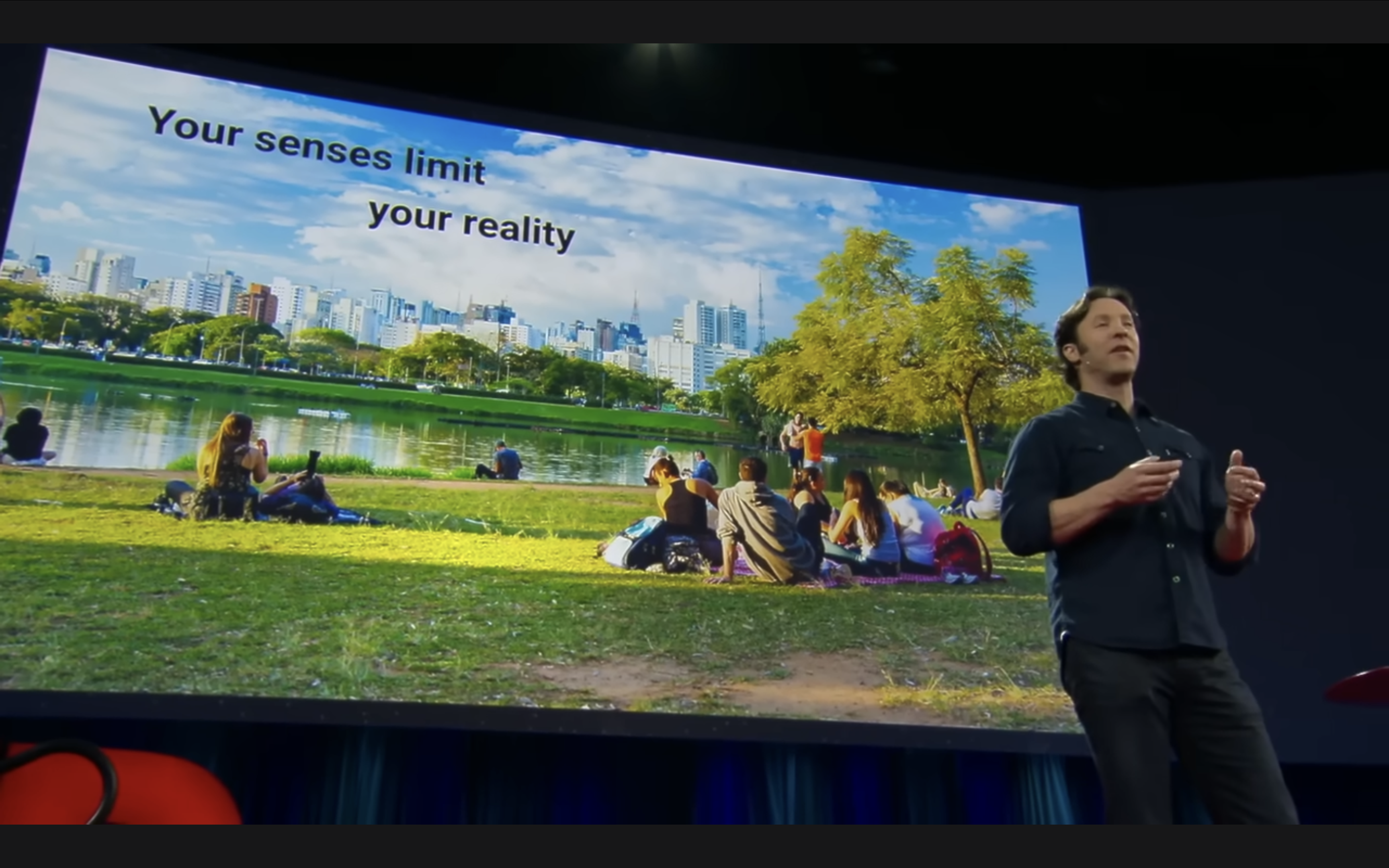
- We’re trapped on a very thin slice of perception.
- But even on that thin slice of reality we call home, we’re missing most of what’s going on.

- Eg. colours of our world. We see less than a 10 trillionth of what’s out there.
- What this means is that our experience of our reality is constrained by our biology.
- This goes against the common sense notion that our senses are just picking up objective reality of what’s out there.
- Instead our brains are sampling just a little bit of the world.

- What we all do is we accept reality as it’s presented to us.
- Your brain is locked in a vault of silence and darkness inside your skull.
- All it ever sees are electrochemical signals that come in through data cables and this is all it has to work with and nothing more.
- Amazingly, the brain is really good at taking signals and extracting patterns, and assigning meaning, so that it takes this inner cosmos and puts together a story of your subjective world.
Dada Gunamuktananda
The exploration of inner space (consciousness) is connected to our discovery of outer space.
- Yogic science has long taught that the Universe’s substance and intention come from consciousness — a deeper reality than the material world we perceive with our senses.
- Consciousness is an all-pervading, blissful awareness inherent in everything; the essence of the universe as consciousness is as valid as viewing it as matter — one can be sensed externally, the other experienced internally.
- A materialist worldview leads to alienation and depression, while a consciousness-based worldview engenders connection, love, hope, and peace.
Finding Consciousness
- Consciousness must be found within ourselves, not intellectually — it’s beyond thought itself.
- As yogic philosophy states: “When I stop thinking, then I really am.”
- Just because something can’t be proven scientifically doesn’t mean it doesn’t exist (like a mother’s love); material science cannot capture the essence of human existence.
- Scientists including Max Planck, Einstein, and neurosurgeon Dr. Eben Alexander (who had a near-death experience) have acknowledged consciousness as a higher reality.
Meditation
- Meditation is a scientific method for validating consciousness through first-hand internal experience, allowing us to realize our individual consciousness is one with universal consciousness — expanding our sense of being and connection to all beings.
Reflections & learnings
Brilliant to see so clearly how science is supporting and validating what can be known first hand through meditation.
Eagleman’s slide states, “each animal has its own window of reality.” My interpretation of this is that, collectively, we each see a little piece of the whole of existence. A “universal consciousness” as Dada Gunamuktananda puts it. It’s beautiful to see the yogic/science connection here.
These talks are showing clearly that reality is not what it appears to be, and I intuitively feel driven to demonstrate this experientially, through my art. Feels nice to have the clarity.