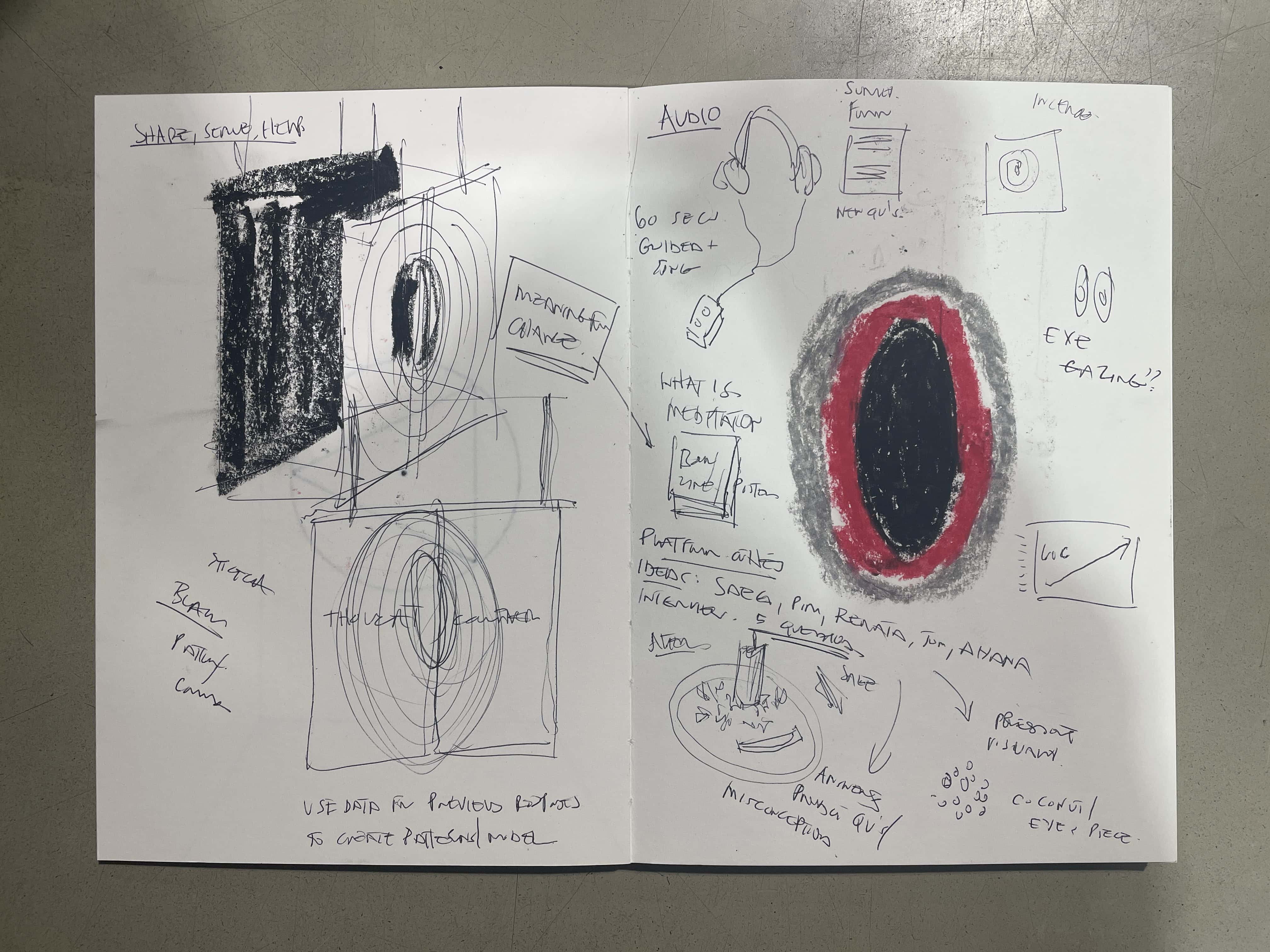
I’ve been thinking about how to expand the next edition of Thought Counter beyond the 60-second investigation.
The challenge since the first iteration is how to create meaningful change after the investigation. What follows are a few ideas I’m exploring – a zine, audio guidance, a guided meditation takeaway – each one a different attempt to offer that next step.
INSIDE THE BOOTH
Refining the ‘noren’ style curtains


The first iteration of the booth was quite raw and there’s an opportunity to refine the look and feel of the traditional Japanese fabric dividers.
It’s possibly worth bringing the 60,000 thoughts p/day claim onto the curtain itself, below the title “THOUGHT COUNTER”.
Rather than stating “Research claims…” as fact, something like “Studies suggest the average person has 60,000 thoughts a day. How many can you count in 60 seconds?” It belongs on the outside as it catches the passerby’s eye and pulls people in.
The previous responses display

This was doing several things at once in the first edition – offering a glimpse of what other people noticed (which validates), and creates a sense of communal investigation.
However, in this edition it can become quieter as the zine and audio takeaway (details below) are now doing the work of contextualising the participant’s experience.
It might be enough to just have the most recent responses stacked together next to the blank forms – so the participant can see other people have also taken part.
Headphones for participant instructions (instead of printed)

The case for headphones:
- Printed sheets keep the participant in “reading mode” – eyes open, analytical, slightly outside themselves
- Headphones invite them inward immediately & create a more immersive, contained experience
- The transition matters – the whole experience (investigation > survey > zine) flows better from a settled state than a reading state
Two possible audio approaches:
- Fully guided – Joseph Goldstein style, voiced throughout
- Framed only – short voiced intro, ambient sound for the 60 seconds, voiced close
- The framed approach preserves the silence and self-direction Thought Counter is built around – the participant does the noticing themselves rather than being talked through it
- Ambient music refs – e.g. Concentration, Dark Loop
- Possible opening cue – instructions to close the eyes, feel into the body, and notice the senses before the counting begins
A way to tie it all together:
- Have different teachers record different versions of the audio
- The voice guiding the participant in could be one of my teachers whose words also appear in the zine
- Turns the whole experience into a single thread rather than separate components
Revising the post investigation questions

The first version (above) asked six reflective questions.
For the next edition, I’m exploring whether four sharper questions would land better – and whether the final question can double as the entry to the audio takeaway. This way the participant answers a meaningful question and the next step (the email capture) appears naturally as part of that answer, rather than feeling like a separate ask:
___
TAKE A MOMENT TO REFLECT
- No. of thoughts you counted vs predicted
- Did you notice thoughts arising automatically, beyond your control?
- In your own words, what did you notice?
- Would you like more control over your thoughts?
- If Yes, enter your email & I’ll send you a series of free guided meditations: ________
WHAT THEY TAKE WITH THEM
Zine – introducing meditation


Inspiration from Zahra Malkani ‘Noorani Echo Sound’, Auto Italia. Photos: Jack Elliot-Edwards
My idea for the zine is to introduce meditation properly to each participant – picked up after the 60-second investigation – including the spiritual dimensions often missing from Western material.
Format: one question per page, answered by two or three of my meditation teachers.
Topics covered: what meditation really is, common misconceptions, what is life force energy, the chakras, the role of a teacher, what to do when practice gets difficult, and how meditation changes a person over a lifetime.
I’ll also include a framing page to introduce the zine. Explaining that the questions are mine and the answers come from 2-3 teachers who have shaped my practice. Why I’m sharing this and and a few words about my own experience.
Process: I’ll hold a one-hour video call with each teacher, sending the questions in advance. On the call, they’ll answer each one in their own words while I record – roughly 100–150 words per answer in the final zine.
Why: This project is deeply personal. It’s a way to share my own spiritual journey, and to give back to the teachers who have shaped it. I believe there’s enormous value in their teachings – and I hope the zine can clarify aspects of meditation that often get lost or oversimplified in mainstream conversations.
Visuals
I thought that the zine could pair each Q&A page with a photograph from my own visits to different spiritual hotspots around the world. Meditation often gets framed in the West as a productivity tool, stripped of context. Whereas the photographs are my own record of visits to Tiruvannamalai in India, churches in Greece or temples in Sri Lanka and Japan are steeped in spiritual tradition. Pairing them with my teachers’ words feels truer to how the teachings actually reach us – through presence and place.


My photos from Tiruvannamalai, India (2025) shot on Canon AE-1 film camera
I’m still working out how to handle two of the pages – the chakras and life force energy – as an illustration would be more useful but the visual language needs to stay consistent throughout.


Chakra system & life force energy references
Audio takeaway
Alongside the zine, I want participants to leave with something of value. An idea is to offer a curated set of guided meditations, ranging from 1 minute to 20 minutes. Each participant has the option of leaving their email address and the recorded meditations are sent afterwards.
This idea has come partly from experience. When I’ve talked with friends and family about meditation and the benefits I’ve felt, they’ve often been curious to try it and asked me to send them something to start with.
It addresses the same challenge the zine is built around – how to create meaningful change after the 60-second investigation. The zine offers context and framing and the audio offers ongoing practice. Together, they offer a tangible path forward.
There’s also room to design the email itself thoughtfully – a short message from me, in keeping with the tone of the framing page in the zine.
Next steps
Teacher confirmation
- Get confirmation from Saeed for the Q&A
- Then approach the other two teachers with similar messages
- Once all three have agreed in principle, send the full question list and schedule video calls
Open decisions to resolve
- The audio approach for the booth (fully guided vs. framed only)
- How to handle the chakras and life force energy visuals
- Final wording on the four revised survey questions
Once the answers are in
- Pair photographs with questions
- Copy for the framing page / personal experience
- Chakra/energy illustrations
- Full A5 zine layout
- Design the audio takeaway email and its short message
Booth and audio
- Record the headphone audio
- Source headphones & software
- Customise the noren curtain including the placement of the previous responses display and the 60,000 thoughts text
- Print the zine