I mentioned my plans for ThoughtCounter during a coffee with my friend Luciano, an architect at Zaha Hadid. I showed him the sphere mood-board and he pointed me toward inflatable architecture as a field. Here’s what I found.
1960s/70s
Ant Farm,Clean Air Pod (1970)


A Berkeley collective who deployed inflatable structures at music festivals and protests, and published the Inflatocookbook – open-source instructions for building pneumatic structures from polyethylene sheeting and tape. The DIY ethos is directly relevant to ThoughtCounter’s prototyping approach.
Haus-Rucker-Co, Oase No. 7 (1972)

Documented in my previous post. A transparent PVC sphere bursting from the facade of a museum.
Coop Himmelb(l)au, Restless Sphere (1971)

A 4-metre transparent habitat that physically moved when its occupant walked inside.
Materials note: All three groups worked with polyethylene sheet and PVC foil – the same family of materials available from specialist fabricators today at low cost. The construction methods were intentionally accessible.
Contemporary architects
Rem Koolhaas / OMA + Cecil Balmond, Serpentine Pavilion (2006)


A vast inflatable PVC balloon canopy over a steel frame. The moment inflatable architecture went mainstream – designed by one of the most celebrated architects in the world for the most prestigious temporary pavilion programme in the UK.
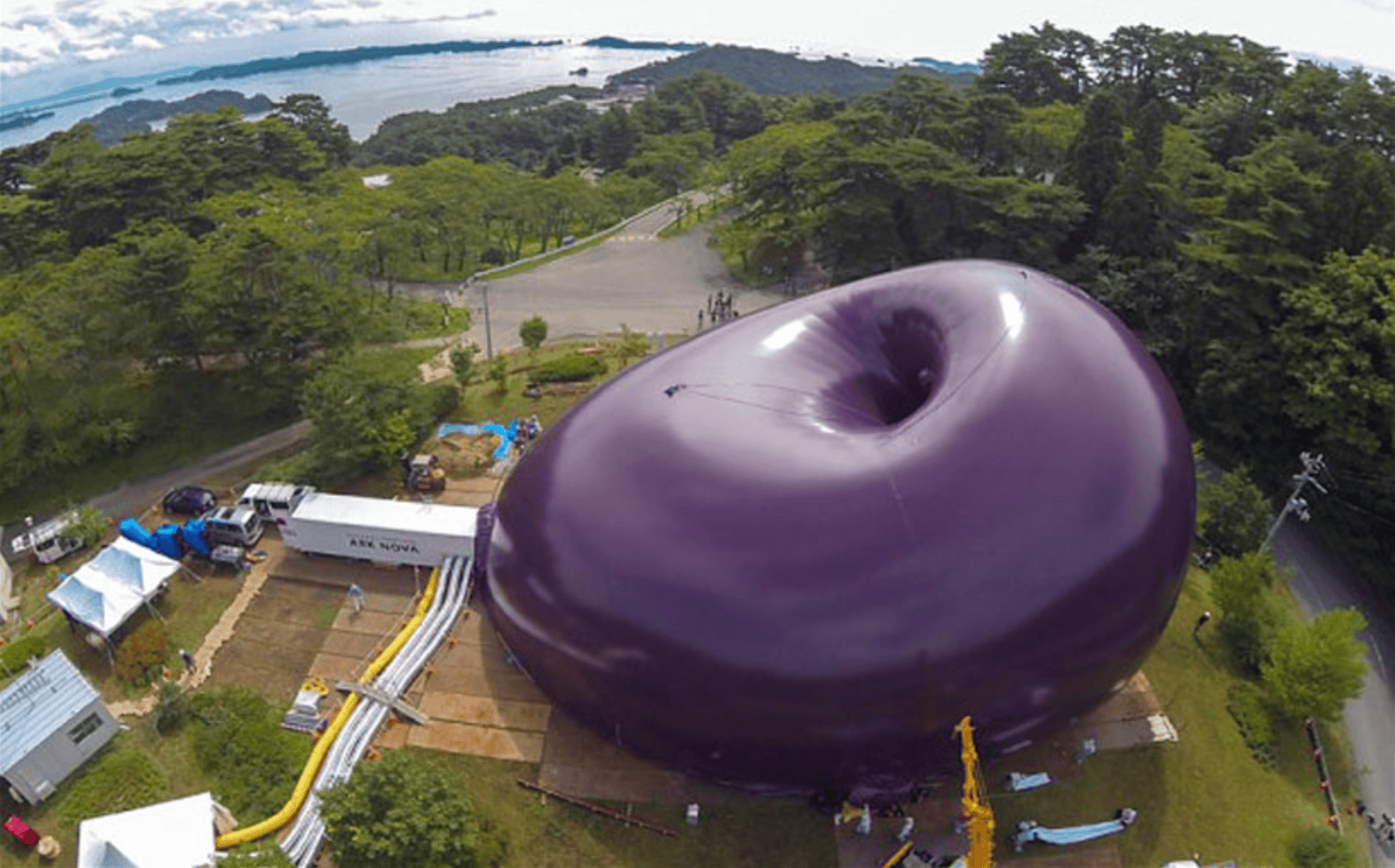
Arata Isozaki + Anish Kapoor, Ark Nova (2013)


A 500-seat inflatable concert hall built in post-earthquake Japan, directly derived from Kapoor’s Leviathan sculptures. Purple-violet, orb-like.


The interior purple walls billow into a spherical shape and are made of a thin, balloon-like sheet.
BIG Architects, SKUM Bubble Pavilion (2016)


An inflatable mobile pavilion made from the same material as bouncy castles, deployable in 7 minutes. The concept drawings are pretty cool too:


Experiential artists
Anish Kapoor, Leviathan (2011)


Visitors walk inside a vast PVC inflatable material in the Grand Palais, Paris – immersed in a deep, dark red interior light.
Tomás Saraceno, On Space Time Foam (2012)


Three layers of transparent inflatable film suspended 24 metres in the air. Visitors walk across the surface, visible to those below – as though they are floating, suspended. Saraceno works almost exclusively with thin transparent polymer film, stretched and heat-sealed.
Materials note: Saraceno’s work uses ultra-thin ETFE film – the same material used in the Eden Project biomes. Lightweight, incredibly strong, fully transparent. Worth researching as an alternative to PVC for the ThoughtCounter sphere.
Smaller scale inflatables
Annabelle Schneider, Breathe With Me (2024, ongoing)


A “womb-like” inflatable volume fabricated by Swiss studio Luft & Laune, tucked between the pillars of an industrial space in downtown Manhattan, synchronised to a polyrhythmic soundscape – designed to positively impact body and mind through rhythmic breathing sounds and soft furnishings.
The closest to ThoughtCounter of all the examples in this post – a portable, soft, contemplative inflatable space designed for inner experience.
Norberto Miranda, Intermittent Dome (2024)


A six-metre-tall clear PVC dome built as a portable “museographic device” for a university in Monterrey, Mexico, with striations of white PVC creating a mise-en-abyme effect and zip-access air cells forming what Miranda claims may be the world’s thinnest shelf – 0.35mm, suspended entirely by air pressure.
Made by specialist fabricator Publiglobos to ensure structural consistency and a see-through finish. A good proof of concept for a functional inflatable room.
Note: The comments section in this Dezeen article (incl. the artist himself) are quite interesting as there’s a discussion about sustainability, air, acoustics (“very parabolic, centre functions as focus and sound bounces perpendicular to the ground.”) etc.
Smiljan Radić / Alexander McQueen, Transparent Dome (2021–22)


A 26m wide transparent inflatable dome, originally built for Alexander McQueen’s SS22 show on a rooftop in East London, then reinstalled at the Old Royal Naval College in Greenwich for SS23 – designed from the outset to be reusable (and touring) for educational and cultural events.
The dome was constructed using a transparent membrane tied and constrained by a net of steel tensile cables connected to a fixed circular base – a technique directly relevant to ThoughtCounter’s structural challenge of keeping a sphere stable without a rigid frame.
Hugh Broughton Architects + Pearce+, Martian House (2022)


A two-storey 53m² inflatable structure on Bristol’s dockside, with an upper level formed from pressurised gold-coated foil – designed as a prototype for life on Mars, powered by solar panels and built to be flat-packed and reused. The inflatable specialists were Inflate and Airclad both UK-based.
Next steps – research
- Materials:
- Ultra-thin ETFE film
- Polyethylene sheet
- PVC foil
- Fabricators/inflatable specialists:
- Luft & Laune
- Publiglobos
- Inflate
- Airclad
- Environment/recycling considerations if using PVC or other plastic materials.
Sources:
https://www.flickr.com/photos/chiplord/2502417965
https://coop-himmelblau.at/first-ten-years
https://www.serpentinegalleries.org/about/press/serpentine-pavilion-2006
https://anishkapoor.com/957/ark-nova
https://big.dk/projects/skum-pavilion-12388
https://anishkapoor.com/741/grand-palais-2011
https://studiotomassaraceno.org/on-space-time-foam
dezeen.com/2024/11/11/norberto-mirandas-inflatable-classroom-monterrey/
dezeen.com/2022/10/13/alexander-mcqueen-smiljan-radic-inflatable-dome-spring-summer-2023-fashion/