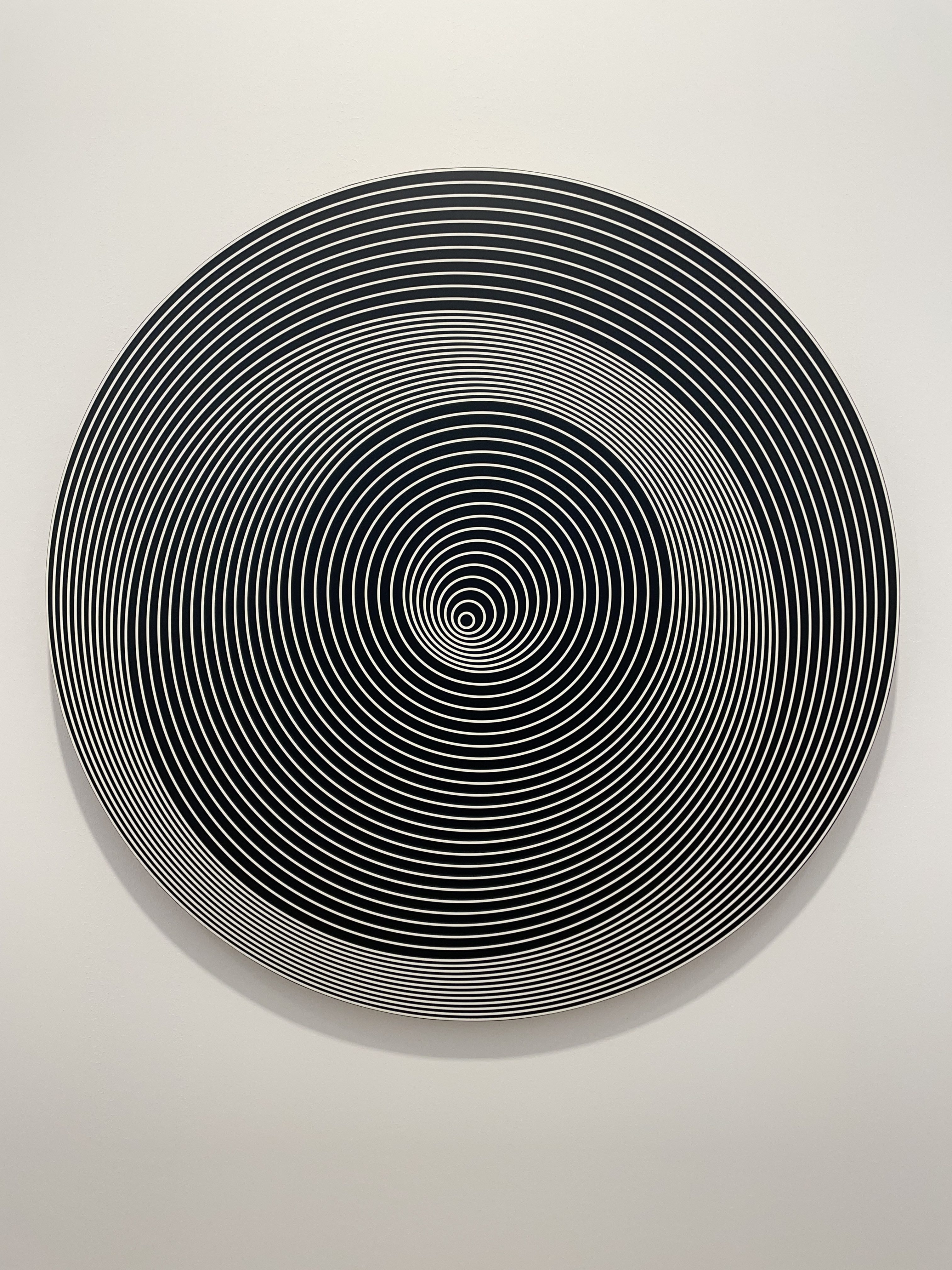
While reviewing my highlights from Frieze, I noticed there were some clear themes that connected to the perceptual alteration research I’ve been doing.
I’m clearly attracted to circles, geometric patterns, op-art, and Indian spiritual art that holds a certain energetic power. I think there’s a really interesting link here: how circles, geometric patterns and op-art works could potentially function as modern-day yantras.
What is a yantra
A yantra is a geometric diagram used in Hindu and Buddhist traditions as a tool for meditation and spiritual focus, typically featuring concentric shapes that draw the eye toward a central point (bindu).
I have a Kalachakra yantra at home (I think it’s Tibetan) which I’ve owned for a few years. There’s a natural attraction to these forms for me, in their beauty, but also their use as a tool for deep meditation.


Kalachakra yantra at my home Marina Apollonio
The distinction
What interests me is the difference between traditional yantras and contemporary work that directly generates perceptual shifts – like Marina Apollonio’s op art functioning as a form of bindu.
Both draw the eye to a central point, both alter consciousness, but one is ancient spiritual technology and the other is modern optical illusion.
A curatorial idea
A dedicated space – almost like a booth with no distractions so the art can be appreciated in a ceremonial way.
Visitors would be encouraged to be present, potentially invited to to a short meditation (or do breath-work) before entering. Enabling them to have more focused attention on the power of the middle point or bindu.

Why it matters
I think that there’s a missed opportunity with contemporary art and the viewing process. Gallery visitors are scanning each piece generally for only a few seconds, and the true beauty and potential power of the work is missed.
“A 2017 study found that visitors to the Louvre spent an average of 15 seconds in front of the Mona Lisa – and most of that time was spent trying to get a photo rather than actually looking at the painting.“
I don’t think any art should be viewed like that. In an ideal world the viewer will be fully present. Some kind of ceremony to really be there, as art is a form of transmission.
Ultimately, I’d like my art to take the viewer to a point of presence. A moment of transcendence. And I think considering the journey to viewing and properly experiencing the art will be a key aspect of this too.
Next steps
- I’ll spend 20 minutes a day for the next few days sitting with my yantra and one piece of op-art, documenting the difference in what happens to my attention, perception, presence.
- What might my own contemporary yantra look like? I’ll spend 1 hour sketching some ideas