I’m developing ThoughtCounter into a collaborative investigation into our thoughts. I’m asking people to participate, contribute their data, and help build something – but I’m not paying them.
So the value exchange needs to be crystal clear in terms of what participants actually get in return. I researched four successful projects that faced the same challenge:
Track Your Happiness, Matt Killingsworth, Harvard
What it is: iPhone app that pinged users randomly throughout the day asking “How are you feeling right now?” and “What are you doing?” to study mind-wandering and happiness.

Key language/framing:
- “The idea is that if we can watch how people’s happiness goes up and down over the course of the day… we might eventually be able to discover some of the major causes of human happiness”
- Positioned as helping solve a fundamental human question
- Used the phrase “help people better understand themselves and others”
- Academic credibility front and center (Harvard, published in Science)
What made it work:
- Immediate personal value: Users saw their own patterns in real-time
- Simple participation: Just answer when pinged – minimal friction
- Scientific legitimacy: TED talk with 5M+ views drove massive awareness
- Result: 250,000 data points from 2,250 subjects, leading to landmark paper “A Wandering Mind Is an Unhappy Mind”
How We Feel, (Yale + Marc Brackett)
What is it: Free app for tracking emotions throughout the day, founded as a science-based nonprofit. Users check in with how they’re feeling, tag factors, and learn regulation strategies.

Key language/framing:
- “Help you gain greater insight around the causes and consequences of your feelings”
- Positioned as “emotional wellbeing tool” not data extraction
- “Thanks to generous donations, it’s available for free” – emphasised the gift/nonprofit model
- “Built by scientists, designers, engineers, and therapists” – credibility through expertise
- Explicit data privacy: “all of your data is kept on your device unless you opt-in”
What made it work:
- Value-first: 144 emotion words, video strategies, personalized insights, weekly reviews
- Social component: Share with friends in real-time
- Nonprofit framing: Removed commercial suspicion
- Result: Apple’s top 15 apps of 2022, 25,000+ five-star reviews
- Celebrity backing: Ben Silbermann (Pinterest) + Marc Brackett (Yale) + featured with Tim Cook
We Feel Fine, Jonathan Harris & Sep Kamvar
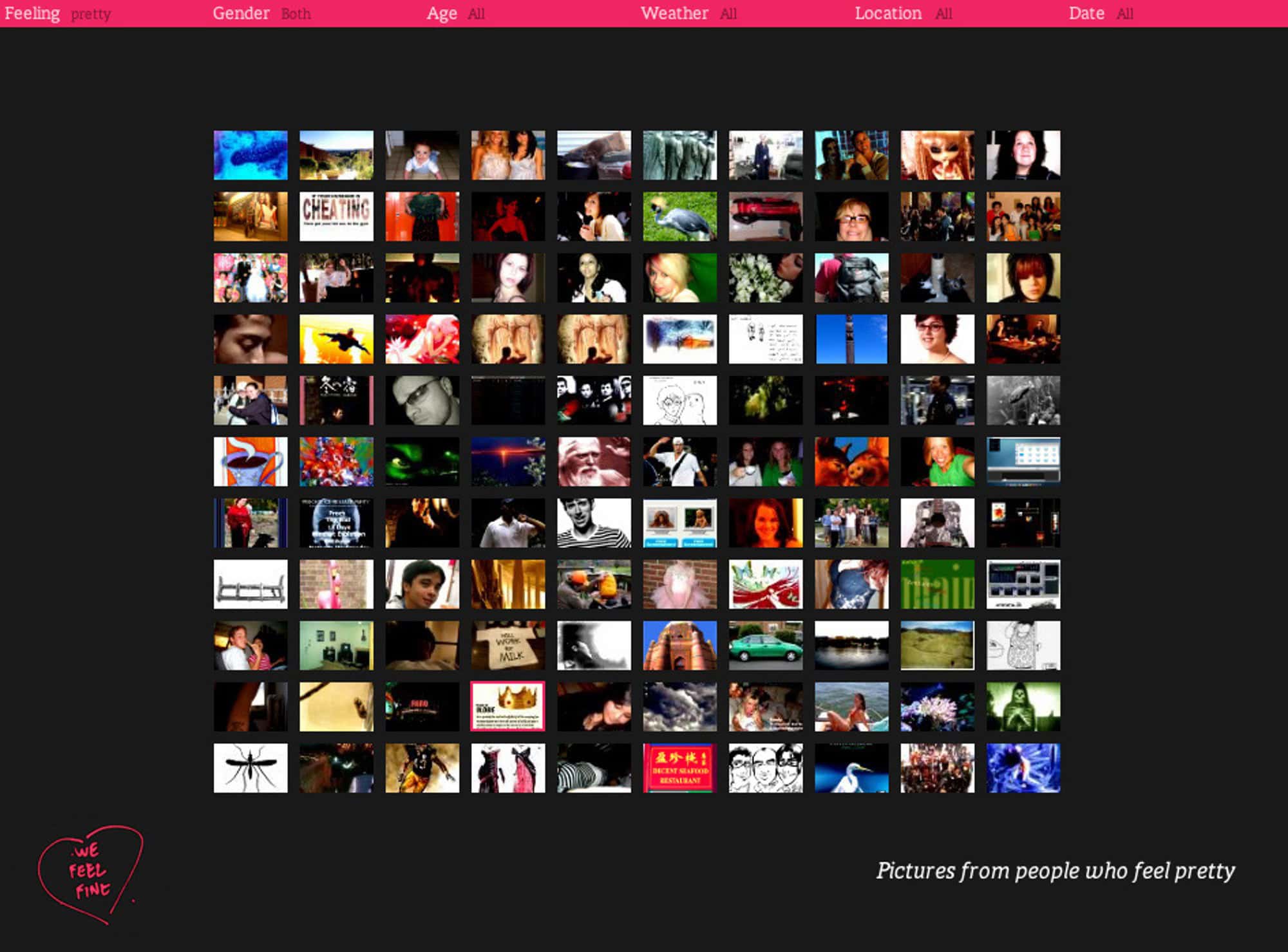
Artistic data visualisation project that harvested sentences containing “I feel” from blogs every 10 minutes, collected 15,000-20,000 feelings daily, visualised as interactive particle system.


Key language/framing:
- “At its core, We Feel Fine is an work authored by everyone”
- “We hope it makes the world seem a little smaller”
- Positioned as art project / collective portrait, not research study
- Called it an “exploration of human emotion on a global scale”
- Culminated in book: “We Feel Fine: An Almanac of Human Emotion”
What made it work:
- Beautiful visualisation – people wanted to see/share it
- Cultural moment: Featured in NYT, Wired, NPR, BBC
- Art context: Exhibited internationally in galleries/museums
- Result: 12 million feelings collected over 4 years
Key learnings
- We Feel Fine presents a solid roadmap for me: “collective artwork” framing + stunning visualisation = share-ability
- Language they used: “Help us understand…” “Join others in…” “Discover insights about…” “Contribute to…”
- Some great strategies to build awareness:
- Academic talks (TED, conferences) created viral reach
- Press features in major outlets (NYT, Wired, BBC)
- Institutional credibility (Harvard, Yale, Oxford) front and center
- Word of mouth through early adopters in relevant communities (Reddit, forums)
- Beautiful design that people want to share
- iPhone app rather than website to reduce friction?