In my last tutorial, we briefly discussed the the show planning and Jonathan suggested: “think about what’s achievable in the next few weeks and what’s strategically useful for me right now.”
With this in mind, it’s not about spending the next few weeks trying to build a perfect installation or even the perfect website. It’s about getting people to reflect on the key question itself, and documenting what they notice or any insights. The research is the work right now.
However, I still have some concerns around getting people to participate. I’m betting that the initial question – “how many thoughts do you have in 1 minute?” – will create some curiosity… but there’s no guarantees. I’ll just have to test it.
I wanted to research other artists or projects who generate curiosity from a line of questioning. Here are my initial findings, and it’s given me a new direction for how to take the interim show forward.
Yoko Ono — Grapefruit (1964)


“Originally published in 1964, Yoko Ono’s Grapefruit: A Book of Instructions and Drawings is a foundational work of conceptual art. This artist’s book contains “event scores,” instructions that the reader may choose to follow in order to perform a proposed piece of art.”
George Brecht — Event scores


“Brecht’s event scores are typically brief texts written in generic, open-ended language that facilitates vast possibilities for performance and experience through its precise imprecision and careful attention to material relations and processes.
The Brechtian event score describes a flexible structure that can accommodate an extraordinary range of content while maintaining the sparest continuity of identity. It forms the basis of a work that is, as Brecht described, “left as open as it could be and still have some shape.”
Sophie Calle — The Blind (1986)


“In 1986, French artist Sophie Calle introduced herself to people attending an institute for the blind in Paris and asked if she might speak with them on the subject of beauty. Calle photographed each person she interviewed and also assembled photographs of one to three scenes or things they named as beautiful.
The conversations took a deeply personal nature, as Calle made clear in excerpts she typed up and framed alongside the photographs. The final work, comprising 23 conversations and more than 80 images, debuted at a Los Angeles gallery in 1989.”
It’s structurally very close to what I’m doing – asking people to report on an inner experience that can’t be observed from the outside.
There’s also a great quote from Calle that’s useful for my participation concerns: “if the approach is playful, many will engage.”
She learned not to fear asking difficult or seemingly absurd questions – people always have the choice to respond, and the unexpectedness of the invitation is often what draws them in.
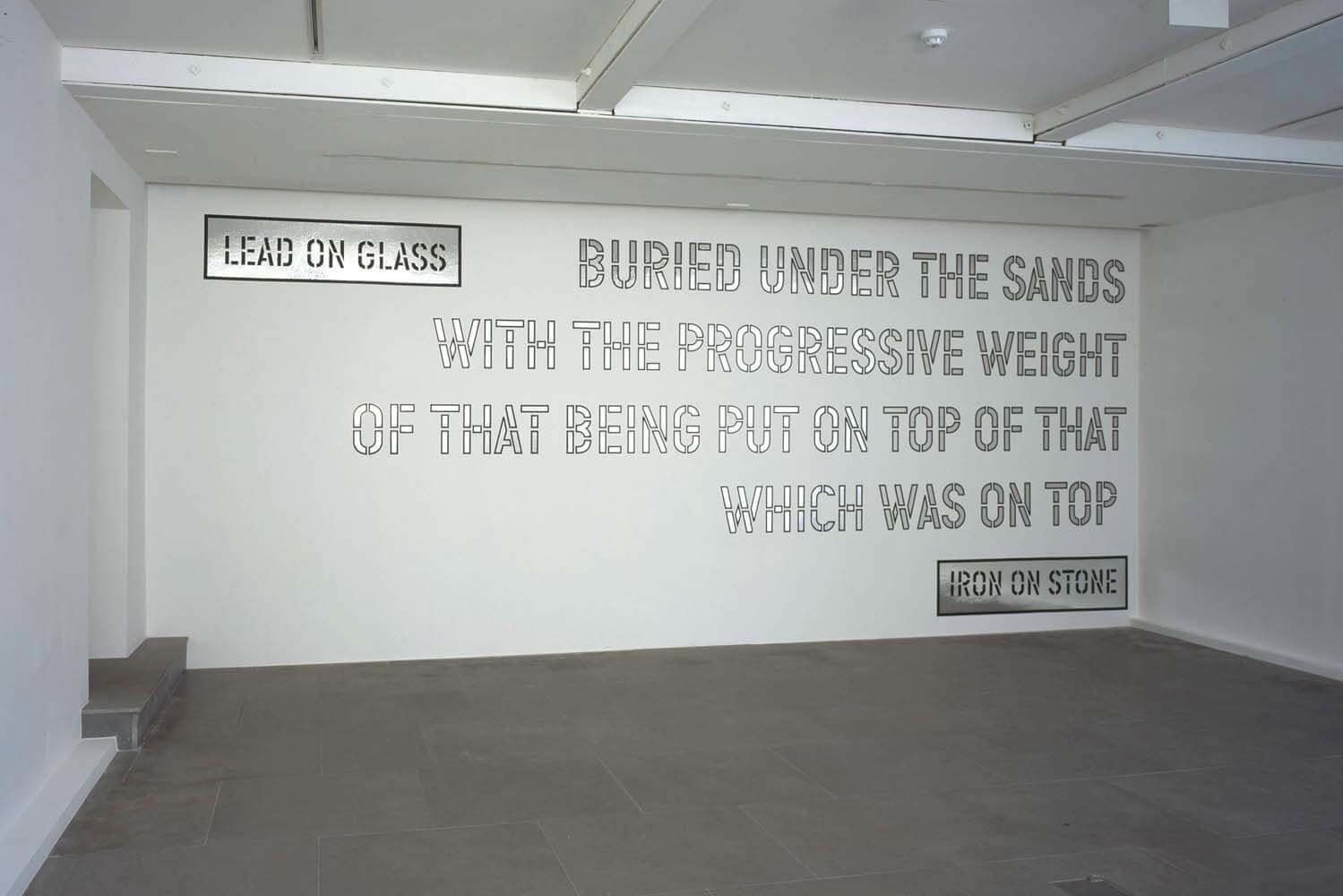
Lawrence Weiner — Various


“Wall installations have been a primary medium for Weiner since the 1970s. They consist solely of words in a nondescript lettering painted on walls. Although this body of work focuses on the potential for language to serve as an art form, the subjects of his epigrammatic statements are often materials, or a physical action or process.”
I’m really drawn to the simplicity of Weiner’s work and the confidence. And personally having a design background, this form of communication resonates with me. I can see how the key ThoughtCounter question maybe appear in a similar way.
Rafael Lozano-Hemmer — Pulse Room


““Pulse Room” is an interactive installation featuring one to three hundred clear incandescent light bulbs, 300 W each and hung from a cable at a height of three metres. The bulbs are uniformly distributed over the exhibition room, filling it completely. An interface placed on a side of the room has a sensor that detects the heart rate of participants. When someone holds the interface, a computer detects his or her pulse and immediately sets off the closest bulb to flash at the exact rhythm of his or her heart.
Obviously this is a more technical approach. Lozano-Hemmer makes the invisible measurable – your heartbeat becomes part of a collective record. That’s the direction I want ThoughtCounter’s accumulation of responses to eventually move toward.
Key learnings & next steps
Seeing these examples of work legitimises, and gives me the confidence to be very direct with my question in the show.
Next steps are to think about how the question can be presented at the show, and what supporting materials I will need in order to document what participants notice and any insights that emerge. And making sure to remember Calle’s quote, “if the approach is playful, many will engage.”
Sources:
- https://library.si.edu/donate/adopt-a-book/grapefruit
- https://www.getty.edu/publications/scores/06/commentary/#fn4
- https://www.moma.org/
- https://www.paulacoopergallery.com/news/sophie-calle-because-the-blind
- https://www.guggenheim.org/artwork/artist/lawrence-weiner
- https://hirshhorn.si.edu/explore/press-images-rafael-lozano-hemmer-pulse/