I’ve spent the last few days looking at artists who use a line of questioning and have been banging my head against a wall trying to decide which direction to go in for the visual direction. Then I had a breakthrough – the art can be a presentation of the research itself.
In my last blog post, I reflected: “…it’s not about spending the next few weeks trying to build a perfect installation or even the perfect website. It’s about getting people to reflect on the key question itself, and documenting what they notice or any insights. The research is the work right now.”
It’s not about how it looks, it’s about: does the question actually work? i.e. Will people stop and engage with “How many thoughts do you have in one minute?” What will they discover when they try to answer it? Where does it confuse them?
So my plan for the next couple of weeks is to test the core proposition with people and document what happens.
Then at the interim show, I can present this research and findings – much like Tehching Hsieh‘s work, where his year-long performance is the artwork and the exhibition just shows the evidence (albeit in a beautiful way).

Tehching Hsieh, Time Clock Piece (One Year Performance 1980–1981)
Similarly, for Sophie Calle’s project, The Blind, the question, responses, and the documentation was the work itself.

Sophie Calle, The Blind, 1986
The practical plan
Last night I created a simple 8-slide presentation which I can shown on my iPhone that guides participants through the experience:
After the investigation, I’ll ask participants to complete a printed A6 questionnaire:

I’m planning to test this with 10-15 people over the next two weeks. I’ll experiment with different conditions. ie. Some with noise-cancelling headphones, some without. And I’ll try to explain as little as possible to see if the instructions and questions work on their own.
The goal is to learn where the experience works and where it doesn’t.
Visuals
I introduced the presentation slides with one of my favourite moiré patterns on the first slide. It signals that this isn’t a standard survey. I feel the optical effect creates depth and draws attention, which feels like the right entry point before asking someone to count their thoughts.
The rest of the design is pared back and simple – Helvetica Neue font in all caps, black and white. The idea of this is for the focus to be on the experience and what people discover, not the presentation. I still need to decide what paper/material to print the questionnaire on.
Confirmation the question is worth exploring
This morning, The Guardian published an article called “Inside voice: what can our thoughts reveal about the nature of consciousness.” It’s an extract from Michael Pollan’s new book, The World Appears, which I pre-ordered last week. Fantastic timing!
The piece profiles Russell Hurlburt, a psychologist who has spent 50 years studying inner experience using a beeper that randomly interrupts people throughout the day. Participants have to recall and record what was in their consciousness the moment before the beep.
His most important finding: “Most of us know very little about the characteristics of our own inner experiences.”
This is exactly what ThoughtCounter will test. I’m asking people to do what Hurlburt does with his beeper, except compressed into 60 seconds.
The article also notes that inner speech – the voice in your head – only shows up in about a quarter of thought samples, with the rest being images, feelings, or what Hurlburt calls “‘unsymbolised’ thought – complete thoughts made up of neither words nor images.“
This matters for my instructions. Defining “any thought counts: a word, an image, a feeling” is important as it reflects how thoughts actually work – not everyone thinks in words.
But the most relevant quote for ThoughtCounter comes when Christoff Hadjiilieva explains why spontaneous thought gets so little attention in research:
“Building a rich sense of identity is not something that benefits the current system. Because if you have people leading meaningful lives and integrating their experiences and realising what really matters to them, that’s just not going to work with how this society runs. You’re not going to need as much stuff.”
This validates the consumer product aesthetic I explored in my previous post, ‘What if ThoughtCounter was a product.’ I noted: “It creates an interesting tension. It’s poking fun at capitalism – we’re spending money and wasting time on the wrong stuff (shopping/consumerism/looks) instead of what really matters: being mindful of our thoughts (which is free).“
So this is one route to explore in due course for the visual aesthetic and it has a strong reasoning.
The interim show
The exhibition will have two parts.
Primary: Research documentation
- Key question & moire pattern, printed large on A-Frame
- All completed questionnaires, displayed
- Summary of findings: the range of counts people reported, patterns that emerged, what surprised them
- Text panel explaining the methodology. ie. “15 participants counted their thoughts for 60 seconds using a clicker pen, then completed a questionnaire documenting what they noticed.”
Secondary: Optional participation
- Suggestion for visitors to try the 60 second investigation themselves
- Framed as “experience what the research participants experienced”
- Materials: pad of anonymous questionnaires, pen/clicker, digital timer
- Responses become part of the ongoing investigation
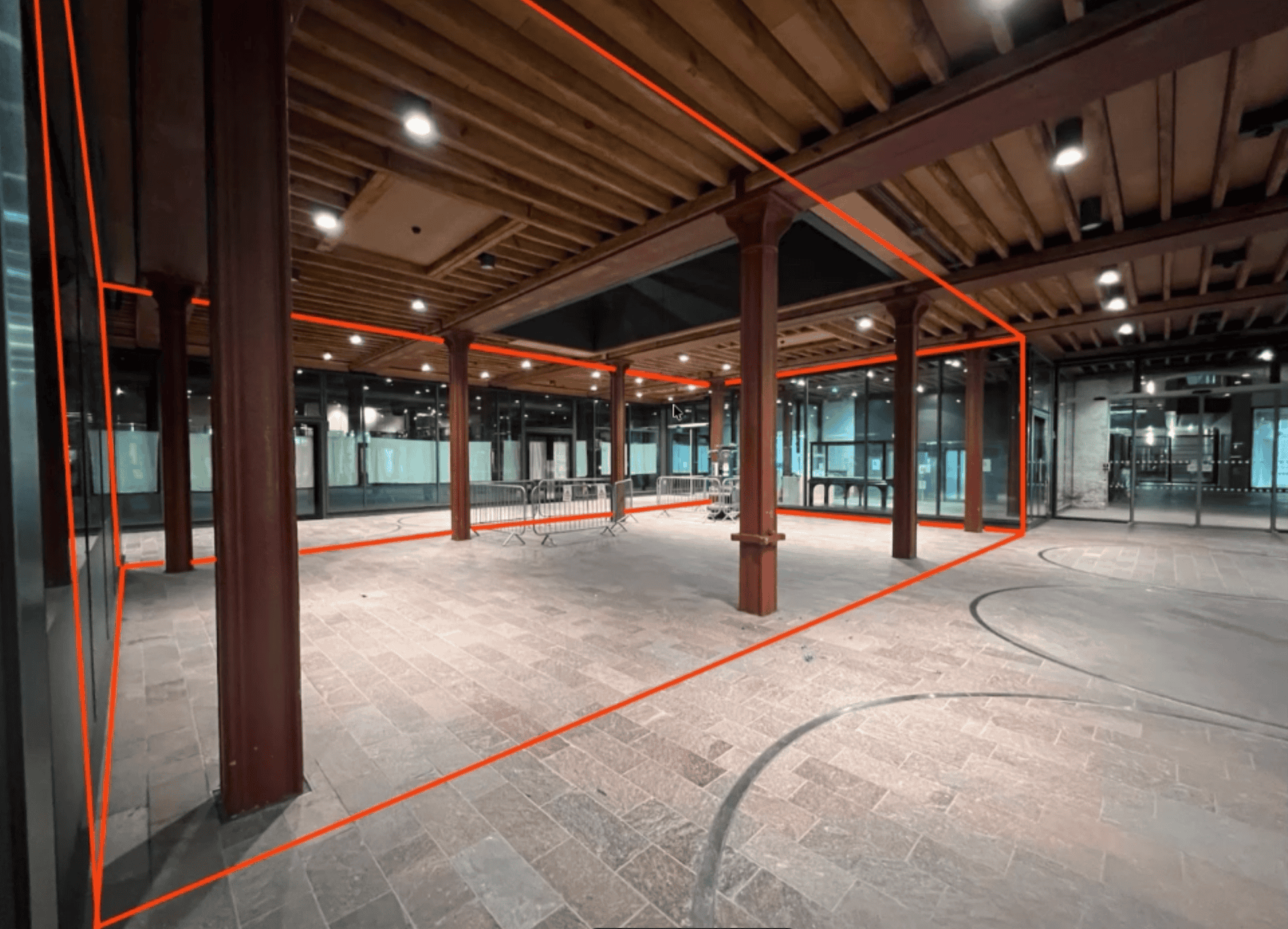
Presentation space:
- Wooden A-frame, measurements: W: 1.2M x H: 2.4M


Next steps
I’ll start testing this weekend and will document everything – what people discover, how their counts compare to their expectations, where they get confused. The show will be an honest account of what I learned.
I need to remember Sophie Calle’s quote:“if the approach is playful, many will engage.”