Research into portable pop up structures for ThoughtCounter.
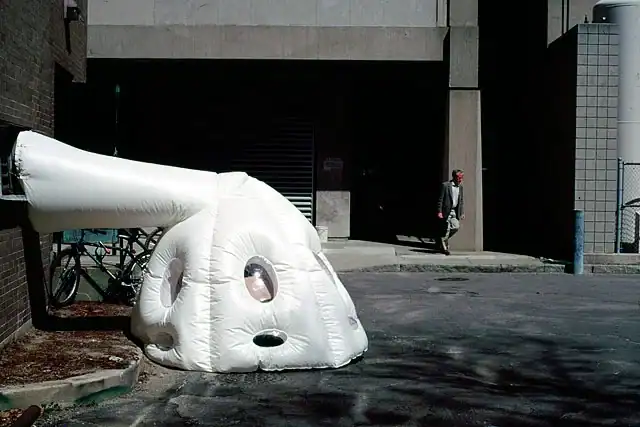
Michael Rakowitz, paraSITE (1998)


Project summary: Custom-built inflatable shelters designed for homeless people that attach to the exterior exhaust vents of buildings, using the escaping warm air to simultaneously inflate and heat a double-membrane sleeping structure.
Materials used: Plastic bags, polyethylene tubing, hooks, and tape – with some shelters constructed from materials as cheap as $5, using bin bags, ZipLoc sandwich bags, and clear waterproof packing tape.
Production method: Each shelter is individually co-designed with its intended user, who specifies requirements such as windows, layout, and form, before being hand-assembled and distributed directly to them.
Do Ho Suh, Fabric architectural installations (1990s–ongoing)


Project summary: Meticulously stitched, life-size replicas of rooms, corridors, staircases, and household features drawn from the various homes the artist has inhabited, exploring memory, identity, and the psychological experience of dwelling.
Materials used: Translucent, coloured polyester fabric, hand-stitched into precisely scaled planes that replicate architectural surfaces in weightless, semi-transparent form.
Production method: Each work is constructed through painstaking fabric stitching to achieve exact proportional accuracy, resulting in ghost-like structures that can be packed flat, transported, and reinstalled in gallery spaces worldwide.
Haus-Rucker-Co, Oase Nr. 7 (1972)


Project summary: A transparent inflatable sphere eight metres in diameter, projecting from the facade of the Fridericianum museum in Kassel as part of Documenta 5, offering visitors a temporary oasis environment – complete with palm trees and seating – accessible via a catwalk through an upstairs window.
Materials used: PVC foil shell, tubular steel, aluminium, and brick formed the structure, with the transparent membrane inflated by a pump to create an enclosed bubble environment.
Production method: A catwalk of standard tubular steel sections projected from the interior of the building through a window into the sphere, with a steel ring fixed to the footbridge forming the external support for the PVC shell, which was inflated into shape by an air pump.
Lucy Orta, Refuge Wear (1992–ongoing)


Project summary: A series of wearable garments that double as portable shelters, developed in conjunction with homeless people, designed to allow the wearer to isolate themselves from the world and create a temporary place of reflection – functioning like a mountain refuge that provides basic comfort before the wearer continues on their way.
Materials used: The Habitent, the founding work of the series, is constructed from aluminium-coated polyamide and polar fleece, with telescopic aluminium poles, a whistle, lantern, and compass integrated into the garment.
Production method: Each piece is custom-designed as a transformable garment-structure hybrid – worn on the body and deployable as a freestanding shelter using the integrated telescopic pole system – with later iterations in the series, such as the Mobile Survival Sac and Survival Duo, extending the concept to collective and multi-person configurations.
Andrea Zittel, A-Z Wagon Station Encampment (2004–ongoing)


Project summary: A series of sleeping pods arranged throughout Zittel’s property in Joshua Tree, California, which twice a year – when the desert climate is mild – she opens to artists, hikers, and researchers, blending communal and private space in what she describes as a “sci-fi pioneer aesthetic.”
Materials used: The second-generation Wagon Stations are constructed from powder-coated steel, aluminium, plexiglass, and wood, with interiors fitted with canvas, a futon, pillow, and basic personal items.
Production method: The metal-and-wood shelters are designed to evoke both the classic family station wagon and the covered horse-drawn wagons of the American frontier, and are fabricated as freestanding, portable pods that can be sited and repositioned across the open desert landscape of Zittel’s A-Z West compound.
Key reflections
The pieces I am most drawn to and inspired by are the first three.
paraSITE is a brilliant concept. Rakowitz has open-sourced the instructions, it’s cheap and easy to erect, and it parasitically utilises existing urban infrastructure – the building’s vents – for warmth. So clever. I’m also drawn to the organic, irregular forms the shelters take on when inflated; the air-bubble aesthetic feels strangely futuristic given the lo-fi materials.
Do Ho Suh’s fabric architectural installations feel directly relevant to ThoughtCounter. They create the sense of a dedicated, contained space while remaining translucent, lightweight, and easy to pack down and transport. That translucency could work particularly well for a pop-up version of the piece – you can see that someone is inside the structure, but the nature of what they’re doing remains ambiguous and private.
Haus-Rucker-Co’s Oase No. 7 sphere maps so perfectly onto the visual language of a thought bubble – it almost feels too obvious, in the best way. It must be amazing to sit inside, elevated and enclosed within that transparent membrane. And from a distance, the form is so striking that it would naturally draw in passers-by – exactly what a mobile version of ThoughtCounter needs to do.
Next steps
Continue researching portable and temporary structures in this vein, and begin developing a mood board and rough sketches for how a ThoughtCounter prototype might look.
Sources:
https://www.michaelrakowitz.com/parasite
https://www.victoria-miro.com/artists/188-do-ho-suh
https://architectuul.com/architecture/oase-no-7
https://m.andrearosengallery.com/artists/andrea-zittel/images