I’ve been thinking about how to develop ThoughtCounter beyond a single installation into a series, and specifically, how to translate the core proposition into an eye-catching but simple, portable structure that can be placed almost anywhere.
Having spent a few weeks of August in Greece – being half Greek and starting to learn the language – it feels like there’s a good reason to use my heritage to inspire this next phase. Not least because Ancient Greek Stoic philosophy is so focused on the nature of thought. This thread came to me a number of months ago (in this post) but the recent visit made it seem more relevant.
Stoicism and Ancient Greece
Ancient Greece is arguably the birthplace of contemplation as a public act. Long before churches and temples became the assumed spaces for reflection, the Greeks had the stoa – a covered walkway open to the public, where philosophers taught and members of the public gathered to think, argue, and work out how to live. Contemplation wasn’t cordoned off into religion, it was practical philosophy, done in a shared civic space.
Alongside the stoa were the temples and monuments, sited at specific energetic points in the landscape understood as places of connection between the human and the divine.
In Ancient Greece the contemplation often happened outdoors – in nature, at particular geological sites, in olive groves. At structures like the Portara on Naxos – a single monumental doorway, standing on its own, framing the sea and the sky – a designated place to stop and look.


Developing this further
Over centuries, people have always designated certain spaces for contemplation – churches, temples, meditation halls, retreat centres. I want to bring these spaces anywhere and make them accessible to all, without the mindfulness or religious connotations.
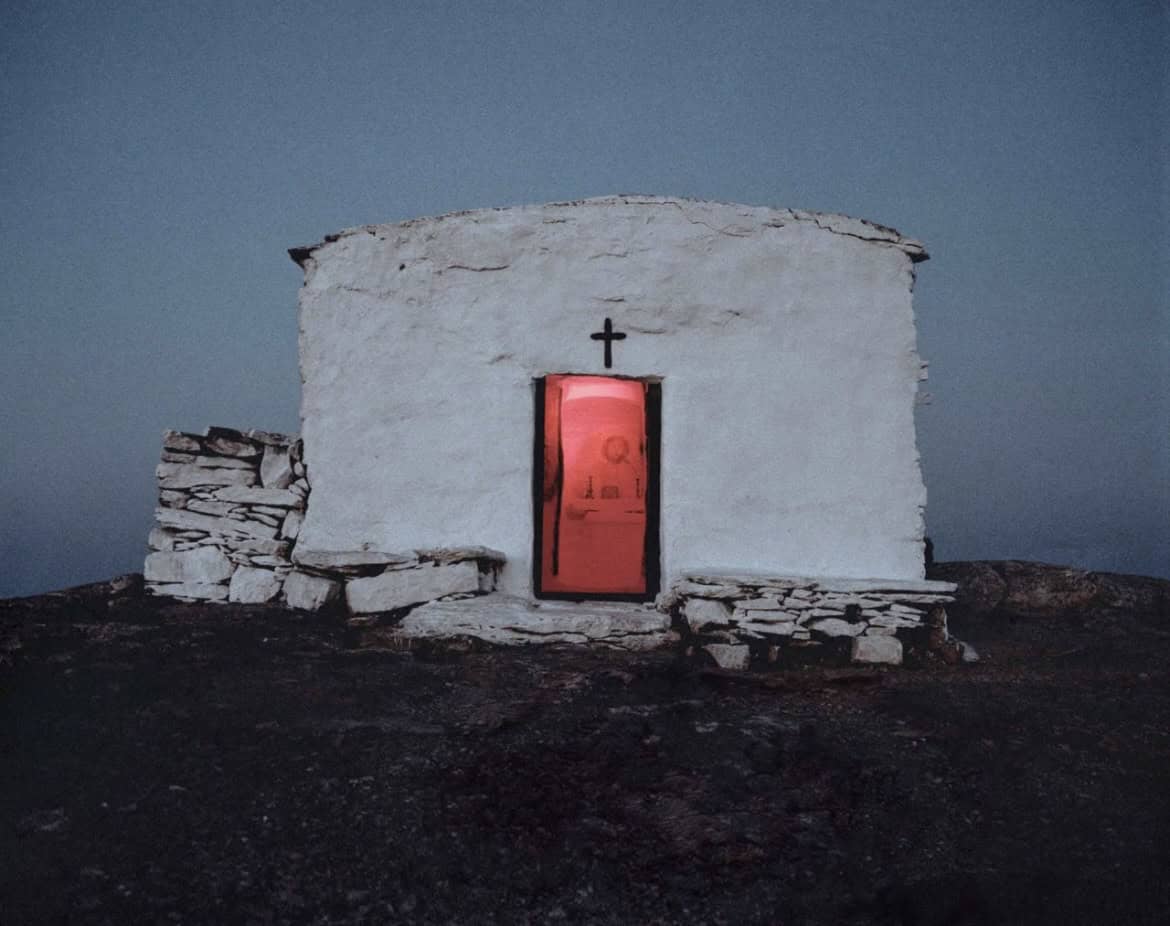
During my visit I was again drawn to the Greek Orthodox churches, like this one in Amorgos, small chapels dotted over the arid mountains and valleys:

My friend Maria’s photograph from Amorgos
What strikes me is how much these small churches achieve with so little – whitewashed walls, a small footprint and a coloured light inside. I wonder if I could riff off this – simplify it further so it works in urban spaces without losing what makes the original so striking.
How could light be used to draw attention? Two artists that come to mind (that I have featured in a previous post) are Jenny Holzer and Bruce Nauman. Both use light as a signal that something here is asking to be looked at.


The use of a simple cube is interesting too. In the same way a meditation cushion or a yoga mat designates a space for stillness, an elegant modern cube could designate a space for contemplation.
I’m imagining a simple backlit cube situated in a public space, with soundproof headphones featuring audio instructions. And an open invitation to participate.


Stephen Antonakos, The White Cube, 1982
A zine or handout given to each participant after the 60 second investigation could include some of key Stoic ideas about thought, for example:

These are ideas the Stoics were articulating two thousand years ago. My vision is to present the ideas plainly, without the mindfulness aesthetic.
I want the ThoughtCounter experience to be transportable – low effort, no barrier to entry, and open to anyone.

Initial ideas and sketches developing this theme.

Film photograph I took in 2024 from the island of Sifnos.
Pierre Sernet, Guerrilla Tea (One series)


Related to this, Daniella recently shared a link to Sernet’s One series, and suggested its relevance to ThoughtCounter. I loved reading the interview with Sernet which helped clarify a lot as I think about how to develop the series.
I was particularly interested in the wooden structure he uses and the reasoning behind it, “the cube as a conceptual space that invites viewers to place their own set of cultural, spiritual, religious or philosophical values inside it.”
The structure is simple, easy to erect and pull down, easy to transport. It intentionally avoids modern technology in order to help forge human connection.
Because the tea ceremony is unfamiliar to most of the passers-by who encounter Sernet’s cube in a desert or on a rooftop, they stop, pay attention, and wonder what the message might be. I’m hoping to spark a similar curiosity when people come across ThoughtCounter – and the other installations in the planned series.
The parallel goes further. Sernet takes a deeply ritualised practice – the tea ceremony – and strips it of its usual container. What remains is the practice itself, encountered without the aesthetic permissions that would normally frame it.
My series hopes to do something similar – it takes contemplative inquiry, strips it of its usual signifiers (candles, cushions, Sanskrit), and presents it as a task inside a piece of contemporary design.
Other artists & artchitects making tea room type structures


xxx


Next steps
I’m going to create a deck (brief + mood-board) as I’d like to discuss the project vision with some potential collaborators. They’ll need something they can respond to visually rather than a blog post.