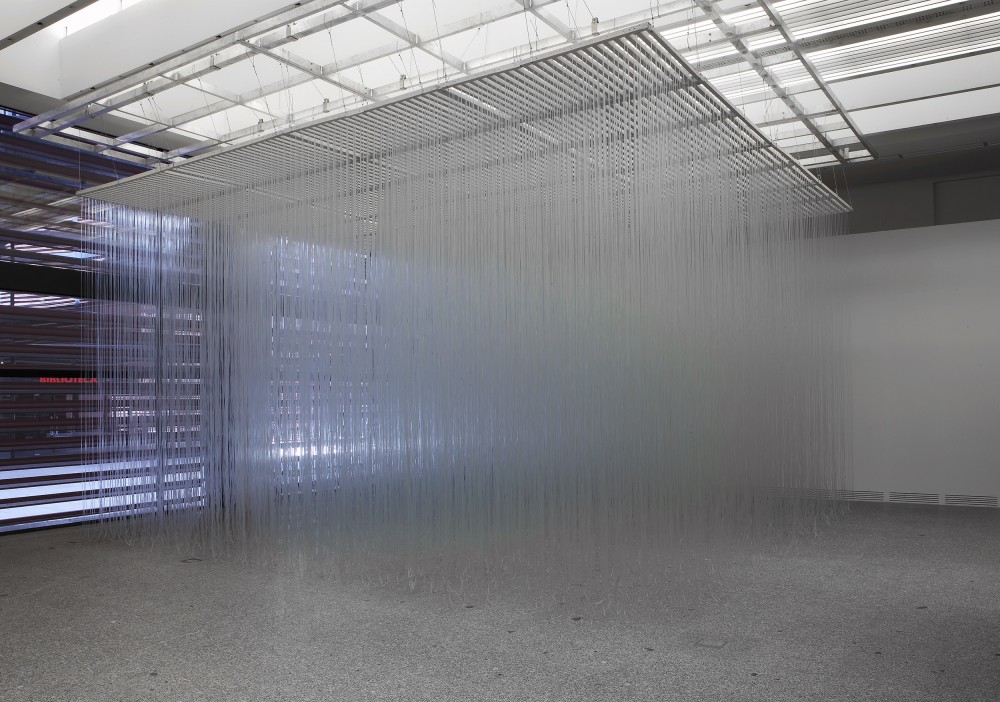
According to Jesus Rafael Soto, “The immaterial is the sensory reality of the universe. Art is the sensory knowledge of the immaterial.” His mechanism: superimposed hatched surfaces producing perceptual dissolution where solid elements appear to dematerialise.
Soto “began as a painter and out of painting developed kinetic relief constructions which gradually grew into autonomous environments.” He “reduced physical motion to sensory vibration”—his work operated through “optical responses to a physically static surface.”

UNTITLED, 1950

UNTITLED, 1950

Metamorphosis from Sotomagie, 1954

Spiral, 1955
Method
Through plexiglas experiments Soto discovered that “their movement could be integrated with optical vibrations: I then began to use these suspended objects—’immaterial curves,’ rods, etc.—which, through the phenomenon of displacement, disappear, to be perceived merely as vibrations.”
He found “the infinity of possibilities offered by the superposition of two hatched surfaces.” The retrospective catalogue I’m quoting from emphasises: “the spectator-turned-participant assumes a position so central that he is no longer divorce-able from the work of art which without him remains incomplete.”

LA SPIRALE, 1958

Spirales, 1967

Mural Panoramico Vibrante Sonoro, 1968

Cube with Ambiguous Space, 1974

Cube with Ambiguous Space, 1981
Science/Theory
Soto’s work investigated time—”the question of time is interjected” through shifted grids and transparent layers. His Penetrables realised “man in his situation, plunged into a ‘full’ universe where space, time and matter become one, in a continuum of infinite vibrations.”
The retrospective also notes: “Soto related Calder’s physical to Vasarely’s optical kineticism, thereby combining palpable and visual kinetic elements into a new form-language.”

Pénétrable, 1982

UNTITLED, 1989

Duomo centro rosso (Dome with Red Center), 1997

The Houston Penetrable


Soto. The Fourth Dimension, 2019
All quotes from: Soto: A Retrospective Exhibition, The Guggenheim Museum, New York
Reflections & learning
- This research is really helpful as I can see clearly how Soto’s work has evolved over the years from painting to creating immersive spaces and installations.
- The ‘aha‘ moment from this research for me is his plexiglas experiments. It seems like a very effective way to make the art come alive, producing perceptual dissolution, whilst providing a very nice transition from 2D to 3D.
- This is something I can test for my early experiments—it’s a lot more accessible than creating full scale immersive spaces off the bat.
- Things that I’m drawn to:
- Simple colour palette (one or two colours max)
- His early drawings (eg. “Spiral”) remind me of some somatic/energetic feelings I’ve had in meditation, which I’ve referenced in a previous post
- “the spectator-turned-participant assumes a position so central that he is no longer divorce-able from the work of art which without him remains incomplete.”—this is very much in tune with the non-dual awareness teachings from yogic traditions
- Connection to Space/Universe :
- “The immaterial is the sensory reality of the universe.”
- “man in his situation, plunged into a ‘full’ universe where space, time and matter become one”
- Spiral/black hole effects produced in some of his early sketches
- Many of the works appear to look like shooting stars
Next steps
- I have some clear acrylic magnetised photo frames at home which would make a great plexiglas substitute—I’m going to do some tests with them this week