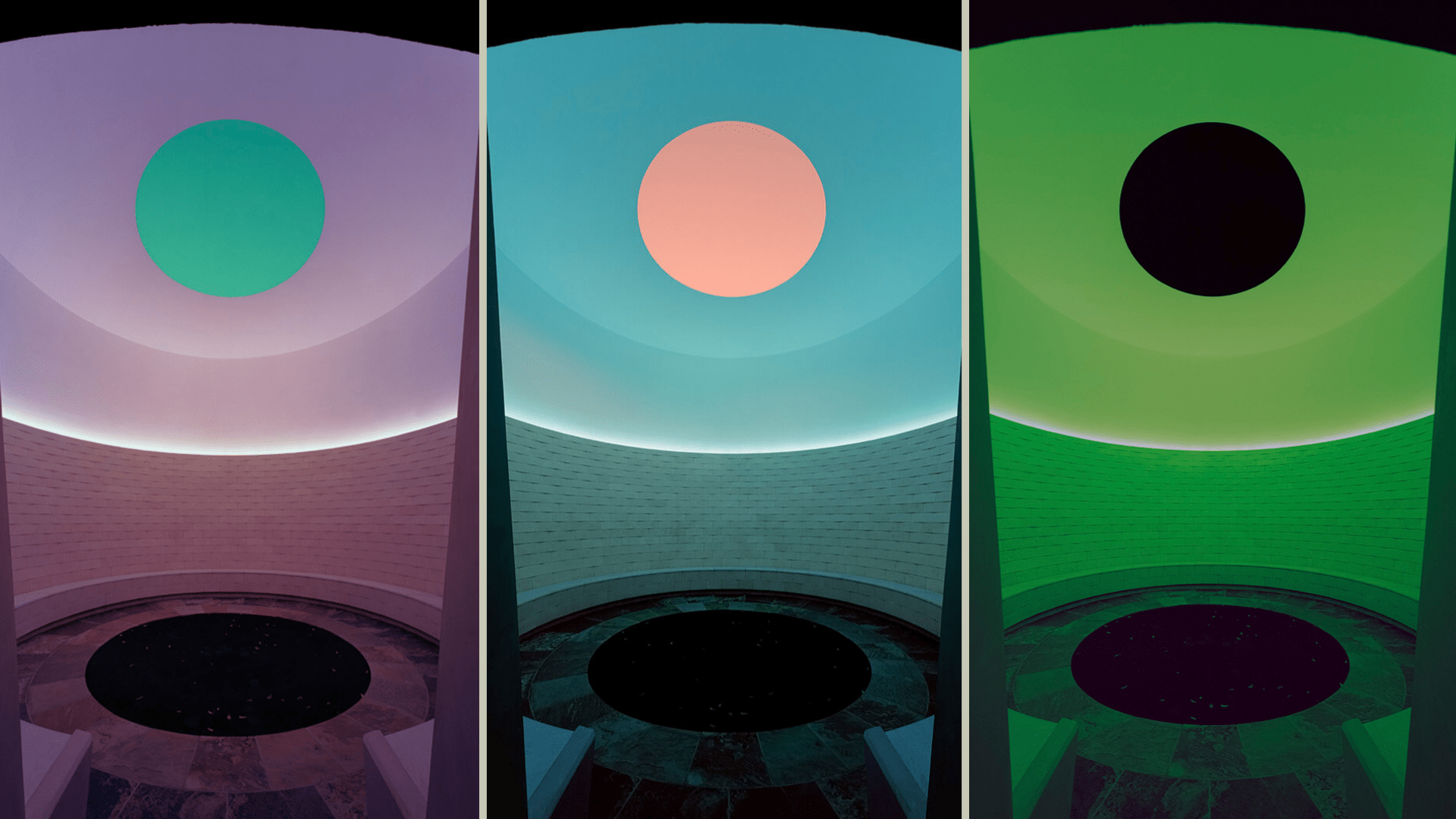
As one of my favourite artists, I wanted to cover this analysis early in my MA to act as an ambitious ‘north star’—not as something to replicate, but to inspire.
James Turrell doesn’t make art about light—he makes art that is light. As he explains of his work, “Light is not so much something that reveals, as it is itself the revelation.”
More specifically, Turrell constructs situations where our perception itself becomes the artwork. As his retrospective book notes, the artist has said that “perception is his true medium.”

As Seen Below – The Dome (2025)
We eat light, drink it in through our skins. With a little more exposure to light, you feel part of things physically. I like the power of light and space physically because then you can order it materially. Seeing is a very sensuous act—there’s a sweet deliciousness to finding yourself see something.
— James Turrell
Core mechanism
Michael Govan writes in the retrospective, “No one has so fully considered the ‘thing-ness’ of light itself—as well as how the experience of light reflects the wondrous and complex nature of human perception.”
Rather than focusing on objects, Turrell isolates light itself as substance, making the immaterial perceptible as material. “No object, only light and perception” the retrospective notes.
His earliest light projections “conjure a material perception of the immaterial.”

Afrum (1967)

First light 1989 (left), Projection piece drawings 1970 (right) & view into Afrum 1966
In Afrum (1967), his first Cross Corner Projection, he described creating “a rectangle projected across a corner in such a way that from a distance there appeared to be a cube floating off the floor.” From a distance this shape had solidity but “appeared to be literally composed of light.”
The mechanism is strategic absence: remove all spatial reference points, and light becomes tactile. Remove the object, and seeing itself becomes visible.
Note: This is the same perceptual phenomena that cognitive scientist Donald Hoffman discusses, as mentioned in my earlier blog post “do we see reality as it is“.

Method
Cross Corner Projections (1966–1974)
Turrell “built a studio from the outside in: he sealed off the two main spaces from all external light by painting the window panes and began to work with projecting light onto the walls.”


First light
He modified a slide projector to create Cross Corner Projections and Single Wall Projections.


Emphasis on geometry: The drawings reveal Turrell’s understanding of geometry, which he used to construct illusions with light. The geometric clarity gives the works a sense of order and structure.

First light (Columns), 1989-90, 3 etchings with Aquatint
Skyspaces (1974-Present)
The retrospective describes Skyspaces as “essentially rooms with apertures that open to the sky” that “afford the immediacy of pure colour and light” while “bringing the sky we take for granted as being far away into our intimate physical space.”

Skyspace: The Way of Colour at Crystal Bridges
The work operates through what Josef Albers demonstrated – that “our perception of colour is entirely dependent on the context within which we see it.”
Turrell “deploys that same principle in his Skyspaces” to make open sky appear red, green, or any colour he chooses.

Gathered Sky, Beijing

My visit to Tewlwolow Kernow Skyspace in Tremenheere Sculpture Gardens, Cornwall
Ganzfelds (1970-Present)
Ganzfelds create conditions where uniform stimulation causes the visual system to generate its own content.
The retrospective explains: “With the Ganzfelds, you use seamless interior covering to erase the architectural information of the space, so that our eyes, which are accustomed to focusing on something, suddenly have nothing to focus on.”
This creates conditions where uniform colour eliminates all depth cues entirely. The book notes that “a Ganzfeld can make a viewer feel both dizzy and off-kilter but also feel a kind of thrill and pleasure. One must surrender to feel that pleasure”.

Perfectly Clear (Ganzfeld), 1991, Mass MoCA

Akhob, 2013, Louis Vuitton, Nevada

Elemental, 2022, Geneva
Central question
His work invites us to “see ourselves see”—making consciousness observable to itself. It also reveals seeing as “an active construction—your brain constantly interpreting, predicting, filling gaps.” By removing objects, he makes “the process of seeing visible.”
Note: “…your brain constantly interpreting, predicting, filling gaps…” is discussed in detail in Daniel Eagleman’s talk, which I covered in a previous post.
Why it works so well
Systematic investigation: Each body of work isolates specific variables:
- Projection Pieces remove spatial reference
- Skyspaces remove the frame
- Ganzfelds remove depth cues entirely.
Experiential & meditative: “The contemplative experience of changing light in a Turrell Skyspace inevitably induces quiet contemplation on the part of its audience.” By “programmed and concentrated exposure to light, Turrell is also able to place the viewer in a ‘theta’ or even ‘alpha’ state of altered consciousness.”
Authentic phenomena: His work produces genuine perceptual phenomena. His pieces create “opportunities for us to experience it as a primary physical presence rather than as a tool through which to see or interpret other phenomena.”
Conditions for receptivity: “Time is required to examine and absorb any work of art. Turrell has routinised that ritual in his Skyspaces.”
Reflections & learning
What draws me to his work
- Simplicity through reduction/isolation — he works with raw elements (light, space, perception) stripped to essentials
- Making the overlooked visible — drawing awareness to phenomena so prominent in our lives yet rarely noticed
- Scientific phenomena made experiential — perceptual phenomena transformed viscerally & visually
- Meditative presence — the spaces create conditions for full absorption
- eg. Copenhagen Contemporary’s protocol to entering Turrell’s Ganzfeld space is like entering a church or mosque: shoes off, no phones, silence, you then ascend about 7 steps before you enter the space / sanctuary)
These questions are what I want my practice to explore too, and I think that’s why his work inspires me and resonates so strongly.
Connection to Yantra Kala (sacred art)
His work could function as what Vedic tradition calls Yantra Kala —art that:
- Guides viewers into direct recognition of their true nature
- Dissolves subject-object duality through experience (ie. “See ourselves see”—only the seeing)
- Transmits non-dual understanding without words
- Uses sensory isolation/enhancement to reveal pure awareness
Resonance with meditation practice
His central questions mirror key yogic self inquiry (Atma-Vichara):
- What is inside/outside? (Antara-Bahya)
- Where does the sky start/end? (Akasha-Sima)
- Where does awareness begin/end? (Chetana-Paryanta)
- Who witnesses? (Sakshi-Svarupa)
- What lies beyond the senses? (Indriya-Atita)
Next steps
- Explore if it’s necessary for my art practise to have it’s own ‘central question’ and, if so, define what that might be—referencing the 4 points from “what draws me to his work”
- Create a mind map using the same 4 points as inspiration and explore from there other phenomena that could be isolated; made visible; or made experiential—and brainstorm ideas how
- Investigate other ways viewers can be placed in ‘theta’ or ‘alpha’ states of altered consciousness—I remember reading about this in Dr Joe Dispenza’s book, “Becoming Supernatural”
All quotes from: James Turrell: A Retrospective (Los Angeles County Museum of Art/Prestel, 2013)