During my recent meditation retreat in India, I attended a brilliant workshop on the Five Aggregates, a foundational Buddhist framework for investigating the nature of self and experience.
The framework resonated immediately with my art practice and research, particularly in how it maps the area I’m exploring through ThoughtCounter.
My friend Tom Hardy was the facilitator of this workshop and his teaching provided a systematic breakdown of how what we perceive as “me” is actually five interdependent, constantly changing processes – from physical form and sensation through to the complex mental patterns we typically identify with.

Meditation retreat workshop – Tiruvannamalai, India, Jan 2026
Below is a copy of the worksheet from the session, followed by some observations on how this framework directly informs my investigation into consciousness and perception.
The Five Aggregates Worksheet
The Five Aggregates (Sanskrit: skandhas) are a core Buddhist framework describing what we experience as a “self.” They show that what we take to be me is actually a collection of changing processes.
The five in experiential order are:
- Form (Rūpa)
- The physical body and material phenomena — including the sense organs and what they contact.
- Personal Consciousness (Viññāṇa)
- Personal, moment-to-moment awareness arising through the senses and mind: The basic knowing of experience as it happens — seeing, hearing, thinking — arising from contact, and distinct from any idea of universal or divine consciousness.
- Feeling (Vedanā)
- The felt tone of experience: pleasant, unpleasant, or neutral (not emotions, just raw feeling).
- Perception (Saññā)
- Recognition and labelling — identifying shapes, sounds, ideas (“this is a face,” “this is anger”).
- Mental formations (Saṅkhāra)
- Beliefs, intentions, habits, reactions, thoughts, emotions, volition — the conditioning patterns of mind.
Why they matter
- They’re used to investigate non-self (anattā): none of these aggregates is permanent, independent, or the real “me.” The True Self.
- Suffering arises when we cling to any aggregate as self or identity.
- Insight comes from seeing them arise and pass moment by moment.
Key observations
When ThoughtCounter participants count their thoughts for 60 seconds, they’re directly engaging with the 4th and 5th aggregates: Perception (recognising “this is a thought”) and Mental Formations (the actual thoughts arising).
Crucially, they’re also encountering the 2nd aggregate, Personal Consciousness: that basic knowing function that watches thoughts arise.
Therefore, in summary, my project creates a controlled experiment where people can experientially investigate what Buddhist philosophy describes: thoughts aren’t “mine,” they’re impersonal processes arising and passing in awareness.
ThoughtCounter also exposes the gap between the observer and the observed – between consciousness (aggregate 2) and mental formations (aggregate 5). The act of counting makes visible what’s normally invisible. This relates directly to James Turrell’s discussion of perception that I referenced in my previous post.
In another post, I referenced this diagram below which visualises “The self as a construct“. It’s in a similar vein to the Five Aggregates framework but from SwamiJ’s interpretation of the Yoga Sutras of Patanjali.

I’m essentially building a contemporary contemplative art practice that uses data collection to investigate the same territory Buddhist practitioner’s have explored for years.
Next steps
Having this clarity in philosophical terms will definitely help to inform my personal study statement and how I develop the project further. In future, perhaps I can aim to address the other aggregates through further work/development.
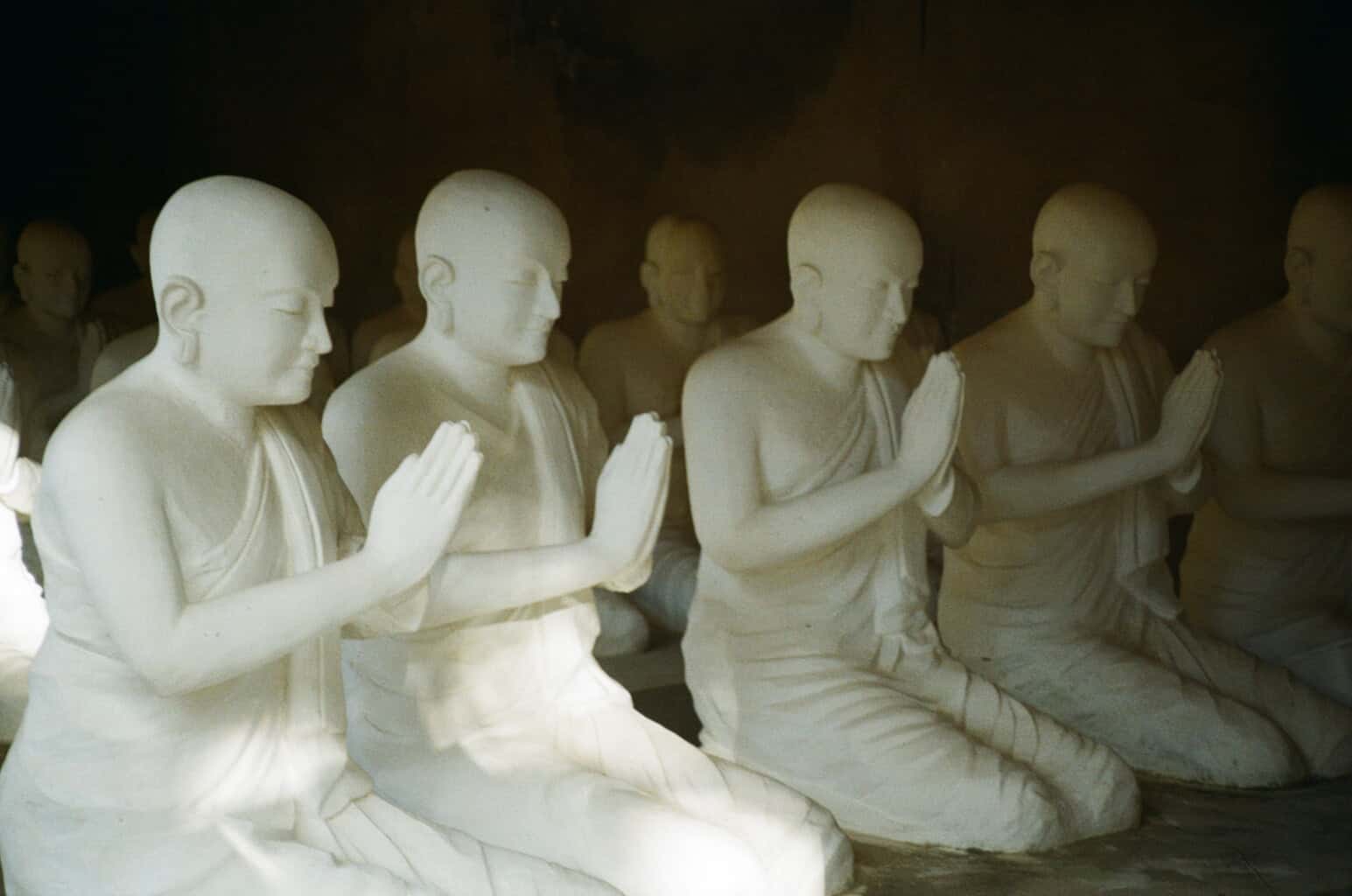
Cover Image: Film photo taken on Adam’s Peak pilgrimage walk. Sri Lanka, Jan 01 2023