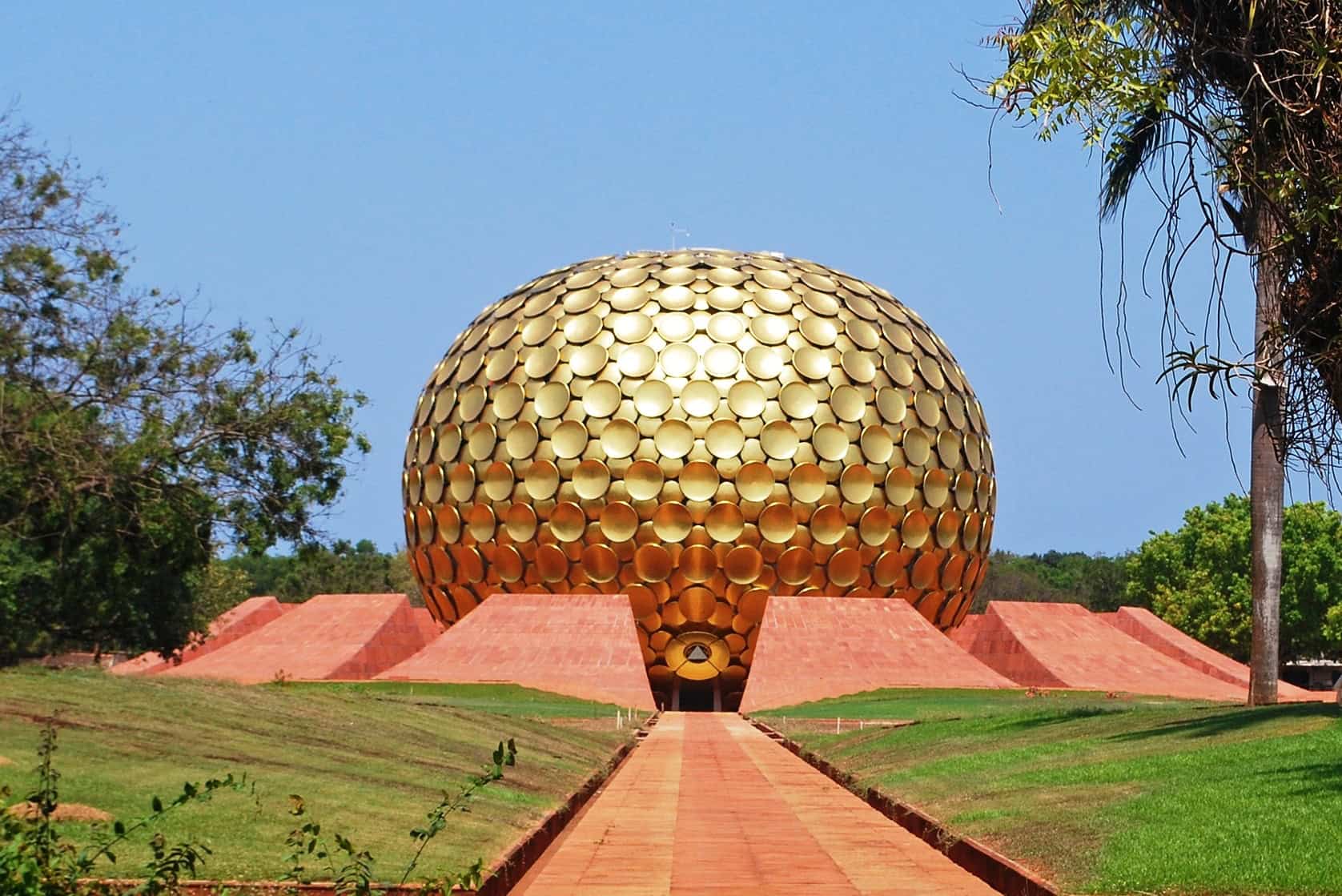
A couple of weeks ago, whilst in India, I visited Matrimandir – Auroville’s meditation chamber at the heart of Sri Aurobindo’s experimental town.
Built in the 1970s, it’s a massive golden sphere dedicated entirely to concentration practice.
The Mother of Sri Aurobindo’s Ashram conceived the idea and communicated her thoughts to architect Roger Anger who translated it into a design.
The temple is now a top destination for meditation and has a footfall of around 1m people per year.
It’s deliberately ceremonial – there’s a build-up through different stages designed to focus your attention and create what they call “one beam of consciousness.”

The Lotus Pond at the base, where people can sit to concentrate

One of the four entrances

Walkway to the inner chamber
Everything inside is white – the carpets, white marble, the socks you’re required to wear. Natural light filters down from above in a way that feels almost Turrell-esque, though without quite the same simplicity.
The whole experience was beyond words. I meditated in the inner chamber for the allotted 15 minutes and went very deep. At the center of the room, there is the object of concentration, the crystal globe, which a beam of sunlight penetrates. I was meditating on that, eyes open, and the energy of the inner chamber felt incredibly supportive and very conducive to transcendental experiences.

Inner chamber
The design language is all circles and spheres, connecting to ideas I’ve been exploring around consciousness and the ThoughtCounter project.
The aesthetic remains futuristic despite being over fifty years old. Perhaps most importantly, there’s no prerequisite. No religious requirement or exclusivity. It’s free to enter and they’re offering a unique space for concentration without trying to convert you to anything.

Architect drawing of Matrimandir
It was a beautiful experience and very inspiring. I kept thinking to myself if it would be possible to create smaller silent spaces like this. The ThoughtCounter installation idea shares some DNA – the ceremonial aspect, no phones/distractions, the circular forms.
Sources: