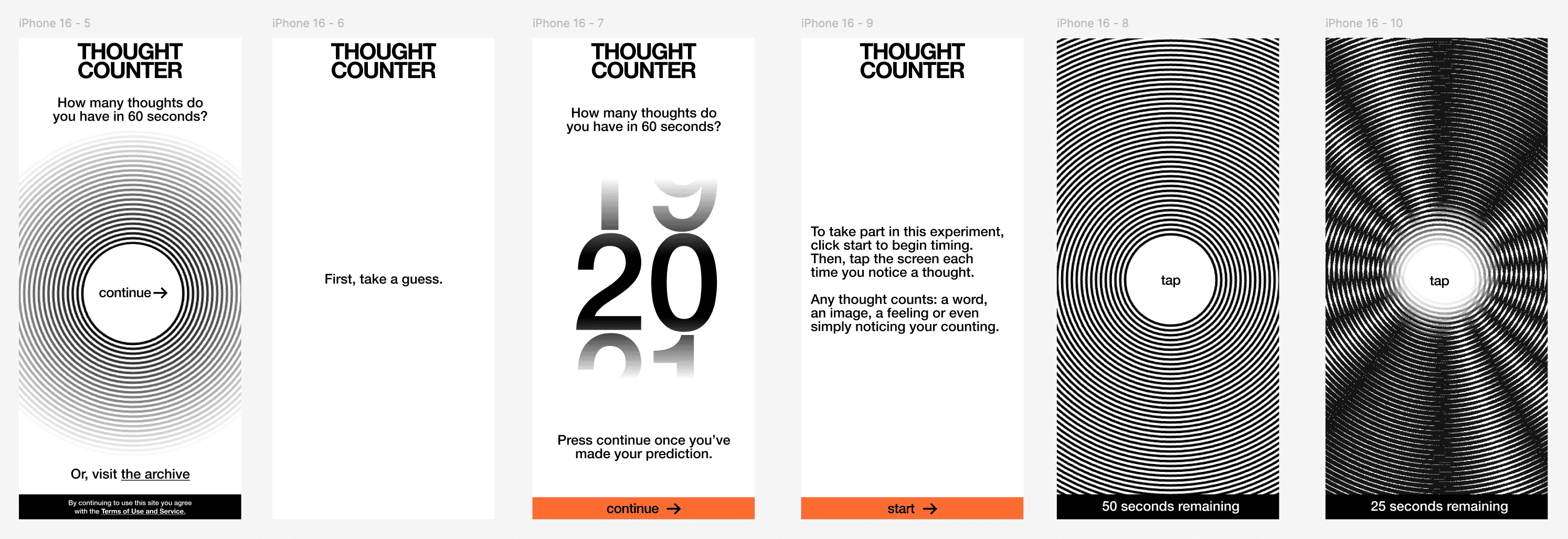
The initial website designs are in. However, after my recent tutorial with Jonathan, meeting Mark Farid, and finalising my study statement it’s apparent I need to make some changes to the user experience. Here’s what I think needs updating and why.

Initial designs for the pre-experience flow of ThoughtCounter
Pre-experience flow needs updating
The flow needs to change slightly from the one shown in the image above to this revised sequence:
Screen 1:
How many thoughts do you have in 1 minute?
Continue →
Screen 2 (instructions):
Click start to begin timing. Tap the screen each time you notice a thought. Any thought counts: a word, an image, a feeling or even simply noticing your counting.
Start →
Screen 3:
60 second timer + tap button
Screen 4 (result + research reveal):
You counted [X] thoughts.
Research claims we have 6,000-60,000 thoughts per day.
Of those, 80% are negative and 95% are the same repetitive thoughts as the day before.
Continue →
Core changes + reasoning
1. Opening question
Original: “How many thoughts do you have in 60 seconds?”
Updated: “How many thoughts do you have in one minute?”
“One minute” feels more natural than “60 seconds” – which implies measurement/data – the framing I want to avoid.
2. Removing the number anchor
Original: Screen 3 asked users to make a numerical guess – a number picker showing 20 as default.
Updated: Remove this page entirely
Jonathan made a valid point – showing a number before the experience can anchor expectations. ie. If someone sees 20, they’ll aim to beat it or feel they should match it. This contradicts the core intent – for genuine open investigation rather than performance against a target.
3. Moving the research stats
“Research claims we have 6,000-60,000 thoughts per day”
Moving these stats after the ‘counting’ experience would validate what participants have just discovered for themselves. Showing the stats upfront risks people performing to those numbers rather than genuinely investigating.

Initial designs for the post experience steps of ThoughtCounter
Post experience changes
Original: Questions covering difficulty, surprise, mental state, negative thoughts, meditation practice, and whether the experience changed their view of mind.

Original wireframe
The original questionnaire was measuring the experience but not tracking impact or intent.
Updated:

Updated wireframe
The updated version addresses my study statement goals directly:
- Q2 captures how people actually describe their experience in their own language – more valuable than fixed options
- Q3 tracks the core insight (automatic nature of thought)
- Q4 tracks any changes in relation to thoughts
- Q5 tracks which audience it’s reaching
- Q6 tracks negative thought %
- Q7 directly addresses if participants express desire for greater enquiry
Summary
The experience now follows a simple flow: one question draws you in, minimal instructions, 1 minute of investigation, your result revealed alongside the research, then 7 short questions about what you noticed and what’s next.
Each stage now creates conditions for direct experience of the thought process, without influencing what that experience should be.
Leave a Reply