It’s clear that people are genuinely curious about their own thoughts, and I was really happy with how the messaging drew them in entirely unprompted.
Now the show and our low residency week is over, a number of ideas and themes are emerging for me to explore in the next stage.
1. Data analysis
I now have responses from 50+ participants collected before and during the show. The first step is to summarise this in a table to identify trends – averaging predicted vs actual thought counts, noting what percentage observed thoughts arising automatically, and pulling out any qualitative insights. This is both academically useful and potentially press-worthy, either now or in due course.
The second step is to consider how to visualise the findings. Although I’ve decided to prioritise experience over data within the installation itself, there’s still value in making the results visible – whether at a future show, on site, or online – as a way of drawing people into the project and demonstrating its reach. What would it look like if the survey responses were flashed on a projector for instance? Like Kaz’s work.

2. Touring / activation
Placing the pop-up in random public locations and documenting everything – the journey, the setup, how people engage with it, the takedown – feels like a natural next direction. It could sit in Dalston High Street, a park, up a mountain, Clifford Chase’s office foyer: the contrast between contexts is part of the interest.
One question is where the piece actually begins – whether that’s the moment I put on the backpack, or the moment someone encounters and enters the space? Permission for public spaces are a secondary concern at this stage, and keeping the structure as mobile as possible, as Andrea suggested, sidesteps the issue anyway.
3. Pop up booth design
For the touring idea, the booth needs to become portable, collapsible, deployable by one or two people anywhere, and aesthetically compelling. Jonathan liked the concept and suggested either a pop-up gazebo with a changeable cover, or bamboo for the frame with a stretch material pulled over it.
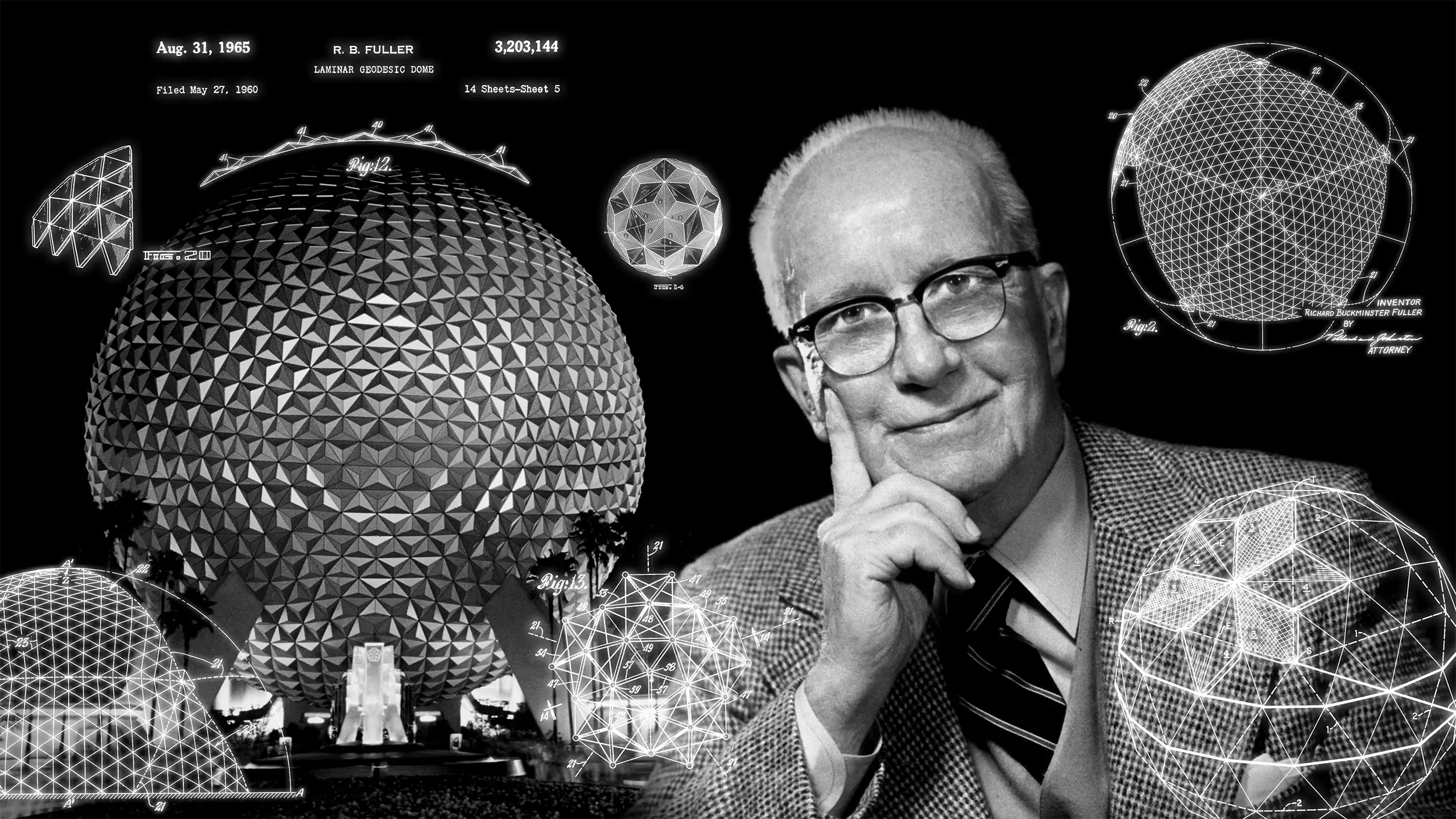
The reference that’s excited me most is the North Face Geodome and I can imagine ThoughtCounter developing in that direction


The design traces back through Buckminster Fuller’s geodesic structures:


And further still to forms like the Matrimandre:

You can see how those references might have travelled through time and influenced the product we see today.
Alex Schady’s workshop pushed us to build large wind and balloon structures from lightweight materials, culminating in pulling everyone’s creations together into one enormous floating worm.


I could push ThoughtCounter’s physical form into something that grabs attention, uses unexpected modern materials, and can still be packed up and taken anywhere.
4. Research paper idea
The form needs a strong conceptual “why” to anchor it – which connects naturally to a research paper idea that Jonathan suggested I explore around nomadic and temporary spiritual structures. eg. Islam prayer mats facing east, octagonal forms, scale and intimacy, the triptych, bowing and lowering oneself.
Investigating why these buildings built this way?
It would be interesting to do all the research to other cultures spiritual / contemplative spaces and then turn it on its head and make something completely different that appeal to today’s younger generations. As per my study statement aim – making it accessible to all.
5. The “what next?” question
ThoughtCounter as a pop up installation is just the start, the top-of-funnel onboarding journey for participants before leaving the booth.
The “what next?” element needs careful consideration – possibly in an email sequence with advice and tips on how to calm the mind, reduce negative thoughts etc. I discussed this with one of my spiritual teachers, Renata, who had some excellent advice.
6. Product development approach
This also prompted me to ask a bigger question: what problem could ThoughtCounter solve for people beyond the installation? I’m going to begin interviewing and surveying participants to explore the barriers around building a consistent meditation practice – and how this project can point toward something more.
7. The audio piece
This deserves its own development track as it didn’t work at the show due to the other noise. The toilet installation is strong – the circularity of it (someone’s thoughts trigger audio about thoughts, which triggers awareness of thoughts in the next person). Speaking to the Spurstow pub and doing an installation for example. I plan to pursue this separately from the booth.
Next steps
I’m going to create a new 8 week plan and develop each of the ideas in this post into their own route, ensuring they align with my study statement objectives and Unit 1 assessment feedback.