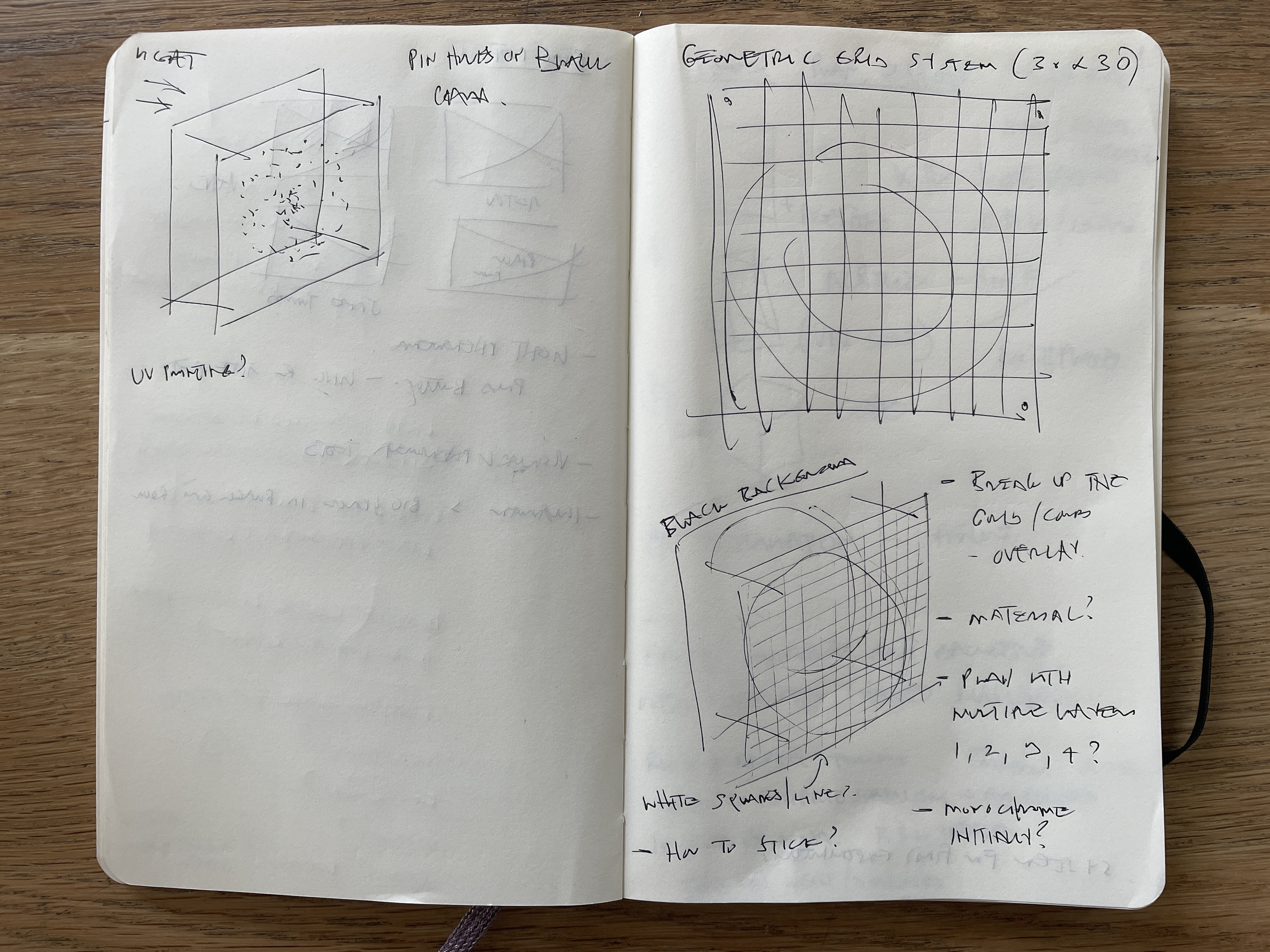
Enough research, here are the steps I’ll take to run my first experiments. Soto’s trajectory has inspired me—starting at pattern creation with the potential to scale up to immersive installations.
In the early phases it’s easy to produce, cost effective and uses materials I have readily available. In the later phases it enables different viewing planes, seeing how light interacts and finally environments where viewers can enter and physically experience.


Phase 1: Digital pattern experiments
- Inspired by recent research into op-art, radial gradients and interference patterns
- Using Illustrator to create 10-15 digital pattern combinations
- Print on paper at 1:1 scale
- Test moiré effects by overlapping printed sheets
- Document the pattern set up/rotation and which combinations work best

Phase 2: Small physical prototypes
- Get A4-sized clear acetate sheets (cheaper alternative to acrylic)
- Print patterns directly onto acetate using inkjet/laser printer, or use transparency film designed for printing
- Test spacing with cardboard spacers
- Photograph results from different angles
Phase 3: Refine design
- Choose 2-3 best pattern combinations
- Calculate exact dimensions for final piece
- Create planning document
- Create technical drawings with all measurements


Phase 4: Acrylic fabrication
- Book CSM workshop inductions (laser cutting, screen printing, drilling equipment)
- Apply patterns to acrylic sheets using chosen method (screen printing, vinyl, or UV printing)
- Cut acrylic to size and drill precise holes for rod placement
- Assemble layers with rods and spacers, maintaining exact distances between sheets
- Create stable base/support structure for display
- Test effects from multiple angles and refine as needed
Note: Katie (my partner) has a multi-plane in her studio which she uses for animation. This could be a nice experimental bridge between phases 4 & 5, where I can rapidly prototype, test pattern interactions and experiment with variable spacing between layers in real-time, without permanent assembly.


Phase 5: Three-dimensional structures
- Transition from flat layered panels to enclosed geometric forms (cubes, boxes)
- Experiment with viewing the effect from multiple angles simultaneously
- Each face of the cube becomes a different viewing plane, creating shifting patterns as viewers move around the work
- Test how patterns on opposing/adjacent faces interact with internal layers
- Consider structural challenges


Phase 6: Immersive installation
- Scale up to room-sized or site-specific installations
- Create environments viewers can enter and physically experience
- Integration with architecture: floor-to-ceiling installations, corner pieces, or works that transform the perception of the space itself
Reflections & learning
- Does it tick all the boxes of my draft MA vision & goals? Not right now, or not yet, but it’s a starting point which I’m excited by
- With this plan I can see how my practice could evolve with logical, achievable steps from initial digital patterns towards the full immersive installations
- I’m sure it won’t happen in that linear way but this feels intuitively right (for now) & that gives me some comfort
- The same broad experimental structure could be used to test the other perceptual phenomena experiments that I’m drawn to. ie. light, colour or yantras
Next steps
- Crack on & create the first test patterns in Illustrator.
- Where else could the patterns coming from?
- Op-art, radial gradients and interference patterns
- Referencing NASA satellite images?
- My early drawings of meditation energies?
- Shapes, geometries & fractals found in nature?